01Reading it
What failure looks like, and what it does not
Most rooflights show their age slowly. This chapter sorts the ordinary marks from the ones that tell you a replacement is due.
Knowing the signs a rooflight has failed starts with how it is built. A rooflight, or skylight, is a sealed glass unit in a frame on a kerb. It can fail in three places: in the glass, in the frame, and in the joint between the frame and the roof. The signs for each are different, and knowing which one you are looking at tells you what has to be replaced.
Not every mark is a warning. Dust, a few spots of dried rain on the outside and a film of condensation on a cold morning are normal. A rooflight that looks scruffy on the outside has not necessarily failed. What you are looking for are changes that do not go away, or that point to heat escaping or water getting into places it should not.
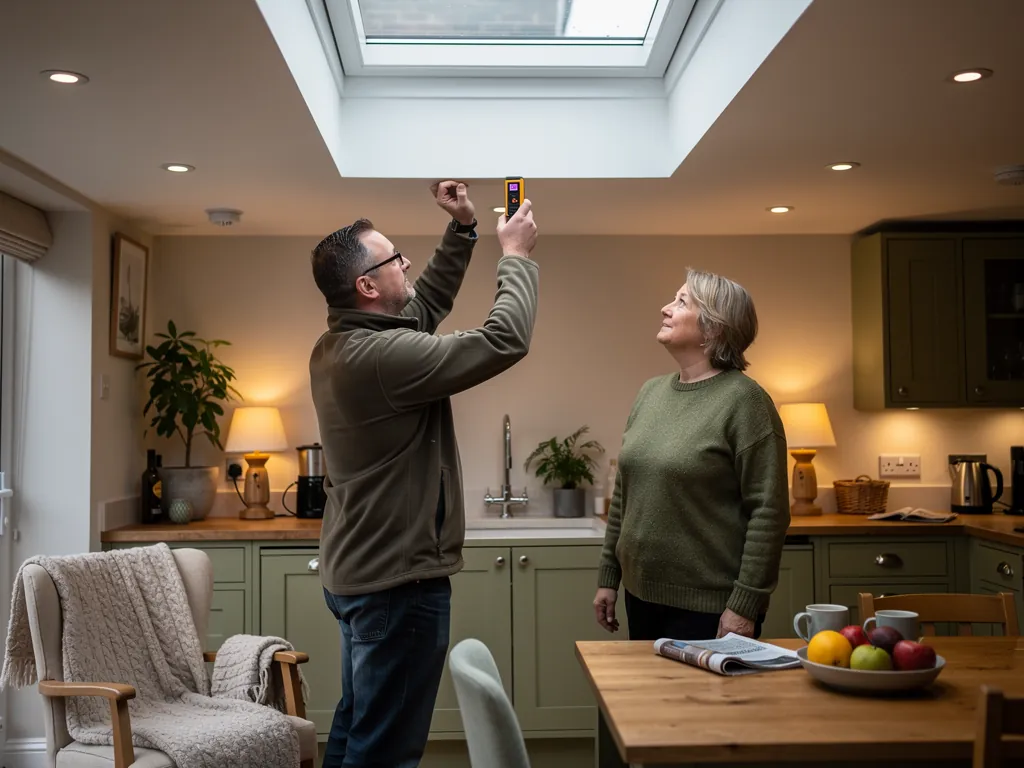
Stand under the rooflight on a bright morning and look up. Then go out, if you can reach it safely from a window or a balcony, and look at the outside. Do not climb onto a roof to check. A fall from a flat roof or a pitch is a bad trade for a diagnosis, and we will look on the survey.
Seasons matter too. Autumn and winter are when most signs show, because the gap between the warm room and the cold glass is widest. A haze that appears in October and stays through spring is far more likely to be a failed unit than a passing mood. Check at different times of day before you decide.
Normal wear
Surface dust, light dirt, a thin film of moisture on the room side of the glass on a cold morning that wipes away and stays away.
A real warning
Haze or droplets trapped between the panes, a stain that returns after wiping, a draught from the edge, or marks spreading on the lining.
02The glass
Signs that the sealed unit has gone
The glass gives the clearest signals. Here is what points to the unit rather than the frame.
The sealed unit is a pair of panes with a gas-filled gap. When its edge seal gives up, damp air gets in and the gap stops doing its job. The pane then shows one or more of the signs below.
- A milky or foggy haze between the two panes that you cannot wipe off from either side.
- Droplets or streaks inside the gap that come and go with the temperature.
- A white or chalky tide line near the edge of the glass, where moisture has dried and left minerals behind.
- A rainbow-coloured film in the corner when the sun hits the pane.
- A pane that looks clear at breakfast and cloudy by teatime, or the reverse.
- Glass that feels noticeably colder to the touch than the pane next to it, on a rooflight with more than one.
Our guide on why rooflight glass mists explains the mechanism behind each of these. The practical point is that none of them can be reversed. A closed unit cannot be opened, dried and closed again, so the answer is a new unit or a new rooflight, and our guide to which of the two to replace helps you choose.

03Room side
Clues you can spot from the sofa
You do not need a ladder to see most failures. The room tells you a good deal about the roof.
Heat is the first thing to give a warning, because a failed unit insulates worse than a healthy one. The room under the glass feels colder in winter than it used to. A cold downdraught, which is air cooled by the glass sinking into the room, can be felt on the back of your neck or on your feet. The heating seems to run harder in that room than in the next one.
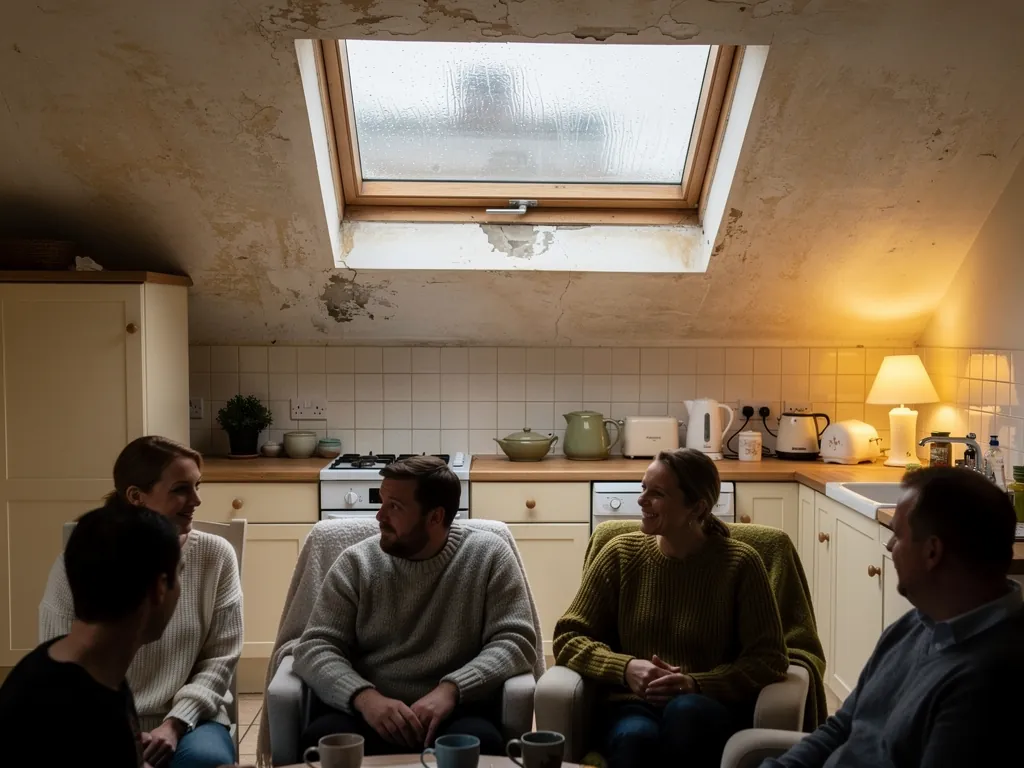
Then there is the lining, the plaster or board that finishes the opening and the shaft below it. If the paint around the opening has begun to bubble, if there are brown or grey stains that spread outward over a season, or if black spotting has appeared on the edge, those are all signs that the rooflight is letting cold or moisture into the lining. The glass may be perfect. The edge is what has failed.
Rooms with a lot of steam, such as a kitchen-diner or a bathroom landing, show these marks sooner. That does not mean the steam is to blame. A well-insulated rooflight stays warm enough on its inner face to cope with ordinary household moisture, so one that keeps clouding and dripping in a busy kitchen is telling you its insulation has slipped.
04Frame and kerb
When the frame, not the glass, is the trouble
A clear pane in a worn frame still counts as a failed rooflight. These are the signs to check on the frame and the upstand.
Frames age by material. Aluminium can show white powdery corrosion or a finish that has chalked and flaked. Timber frames can darken, split and soften, particularly at the lower edge where moisture lingers. uPVC can turn yellow, bow or crack. A frame that has moved can stop the glass sitting square, and a unit that sits under strain fails sooner.
The kerb is the raised edge that carries the frame on a flat roof. A soft, spongy or blackened kerb is a failed kerb, and a new unit on top does nothing for it. Where there is a gap between frame and kerb, you can often feel cold air at the join on a windy day, and see a line of grime where the air has been flowing.
| What you see | Where it points |
|---|---|
| Haze between panes | Sealed unit |
| Powdery white edges on metal | Frame corrosion |
| Soft, dark timber at the base | Frame or kerb |
| Cold air at the frame edge | Frame-to-kerb joint |
| Stains spreading on the lining | Surround, kerb or frame |
05Water
Drips, marks and the questions they raise
Water inside is alarming, but it has two quite different causes. Telling them apart saves you from replacing the wrong part.
Water on the room side of the glass is usually condensation. Warm, damp household air meets a cold surface and turns to droplets, which run down and drip from the frame. It is common in kitchens and bathrooms, and often means the glass or the frame is losing heat faster than it should. Our page on why a rooflight drips in winter goes through that case.
Water that appears after rain, runs from the corners of the opening or leaves a tide mark in the same spot each time points to something else: the junction between the frame and the roof covering. That junction depends on the flashing, the upstand and the way the frame was set. When it has failed, the fix is to replace the rooflight or the upstand properly, not to guess.
Keep a note. Does it happen only on cold mornings, or only after heavy rain? Does it happen on one side of the opening? Those answers tell a surveyor where to look first, and they cost you nothing to gather.
- Wipe the room-side glass dry and watch whether the drops return on the same cold mornings.
- Note whether the marks follow rain, even when the house is cold and dry.
- Photograph the stain, with a coin or tape for scale, and date it.
- Check again after a week, to see whether it has spread.
- Share the photos with us when you ask for the survey.
06Age
How old is old for a rooflight
Age alone does not condemn a rooflight, but it sets the odds. Here is how to weigh it up.
Sealed units are made to last, and many do for a long stretch. Their life depends on how they were made, how they were fitted and how much punishment the roof dishes out. A south-facing pane in strong sun swings through a bigger range of temperatures than a shaded one. A unit that sits on a flat roof where water lies around it ages faster than one that drains.
If you do not know how old your rooflight is, look for a date stamp on the spacer inside the glass edge, or a label on the frame. Or ask the builder who made the extension. A rooflight from the first decade of double glazing may have a thin unit with no coating, which was fine at the time but loses heat quickly against what we fit today. Our guide on how long sealed units last sets out what affects that life.
Think about the extension too. Single-storey additions and loft rooms across Basildon, Wickford and Rayleigh were built with a rooflight that was bright but thinly glazed. If yours is one of those and now shows signs, a replacement is a chance to bring the glass and the frame up to a standard that keeps the room warm.
- 2panes in a standard double glazed rooflight unit, with a gas-filled gap between
- 1.4W/m²K, a good figure for a double glazed rooflight today
- 10years, the term of our workmanship guarantee on a replacement we fit
07Next step
What to do once you have spotted one
You have noticed a sign. Here is what to do about it, in a sensible order, without rushing.
First, decide which part you suspect: glass, frame or surround. Use the table in this guide, then ask for a survey. We look at all three, because a cloudy pane can sit in a perfectly good frame, and a clear pane can sit in a failing one. Our overview of misted and failed rooflights shows how the whole subject fits together.
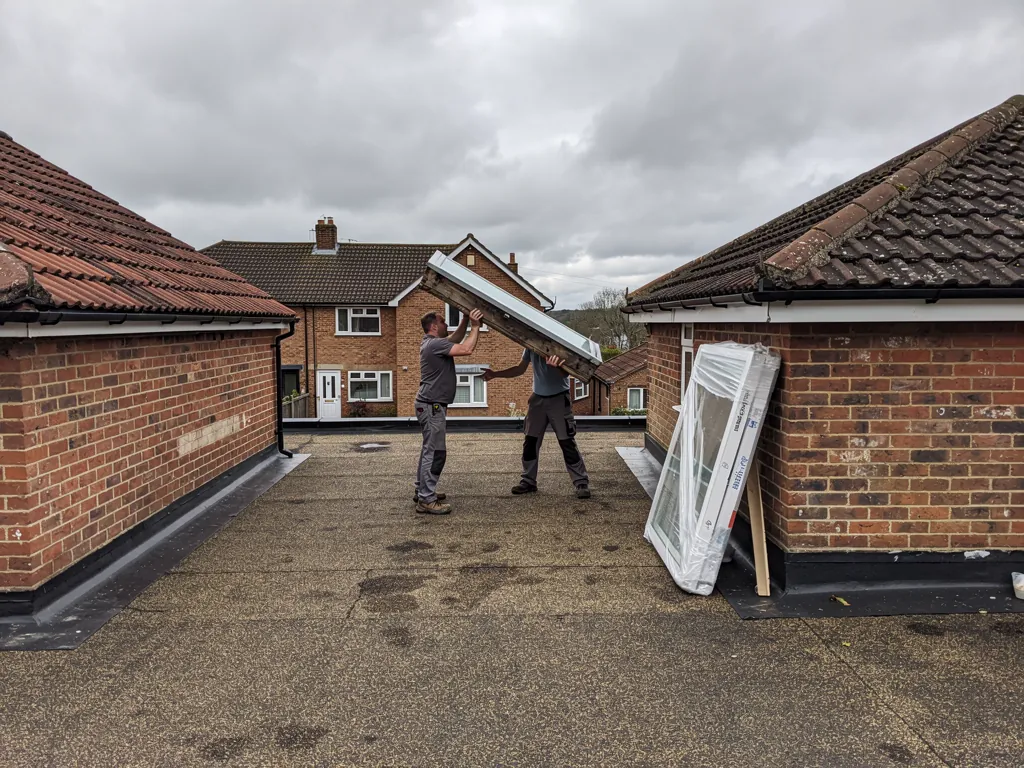
If only the sealed unit has failed and the frame is sound, replacing the unit is not notifiable. Once the frame has gone, or the whole rooflight is coming out, the new one is a controlled fitting under Part L. We notify Building Control, and the new rooflight must meet the limiting U-value. Our guide to the Building Regulations for rooflights covers the detail.
The survey is free and the quote is written. One fitting team does the job, floors and furniture are protected, and the new glazing is warm-edge as standard, so the room you get back is bright and holds its heat.
Do not wait for the first heavy frost to find out how bad it is. A failed unit gets worse as the seal weakens, and the cold edge around it damages the lining the longer it goes on. Booking a survey in a calm spell means a replacement can be planned, rather than rushed.
Cloud between the panes means the glass is finished, and cold at the edge means the frame is telling you something too.
Spotting a tired rooflight: what to ask
How can I tell condensation from a failed seal?
Condensation sits on the room side of the glass and wipes away. A failed seal leaves haze or droplets between the panes, where no cloth can reach. If the cloud is inside the glass, the unit has failed.
Does a cloudy pane mean the whole rooflight is finished?
Not always. If the frame and kerb are sound, the sealed unit alone can be replaced. The survey tells you which route suits your roof, and the quote shows both where it is not obvious.
Will a failed rooflight make my heating bill rise?
It can make that room colder and the heating work harder, because a failed unit loses its gas fill and insulates worse. A new warm-edge unit or a whole new rooflight brings that back.
Is a stain on the ceiling always the rooflight?
No. Stains can come from pipes, the roof covering or condensation elsewhere. But a stain that follows the outline of the opening and grows is a strong sign that the rooflight, the kerb or the lining around it needs a look.
Can I check the roof side myself?
Look from a safe window or balcony only. Do not climb onto a roof. We examine the outside, the frame, the kerb and the glass on the survey, so you do not have to take any risk.