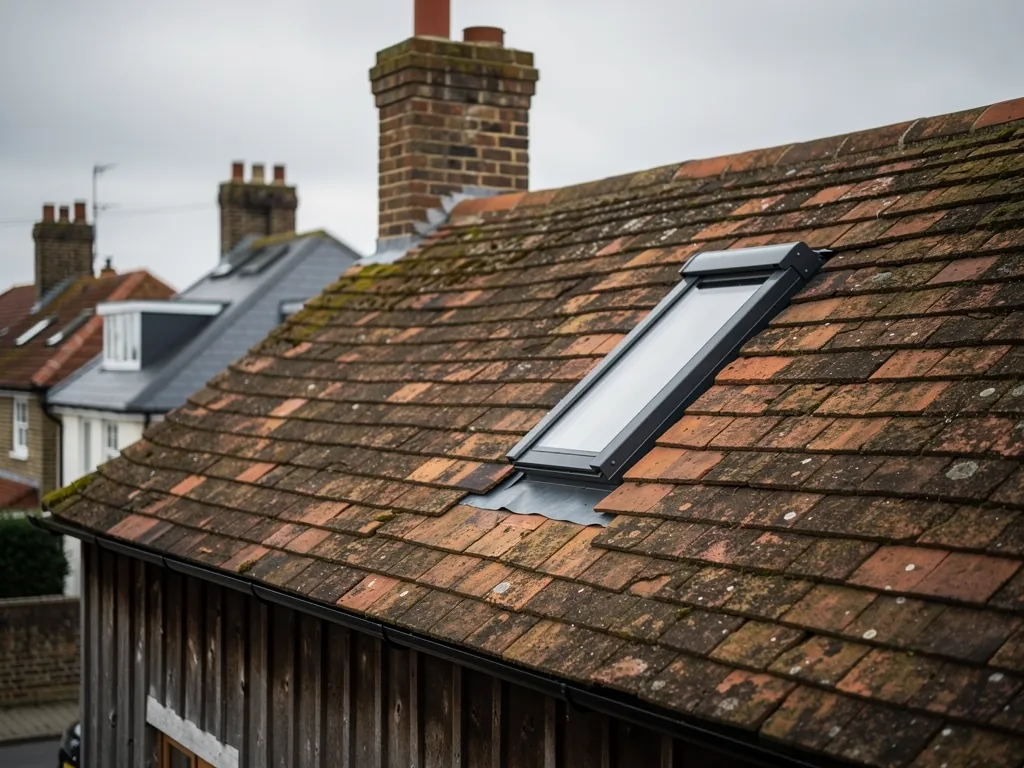
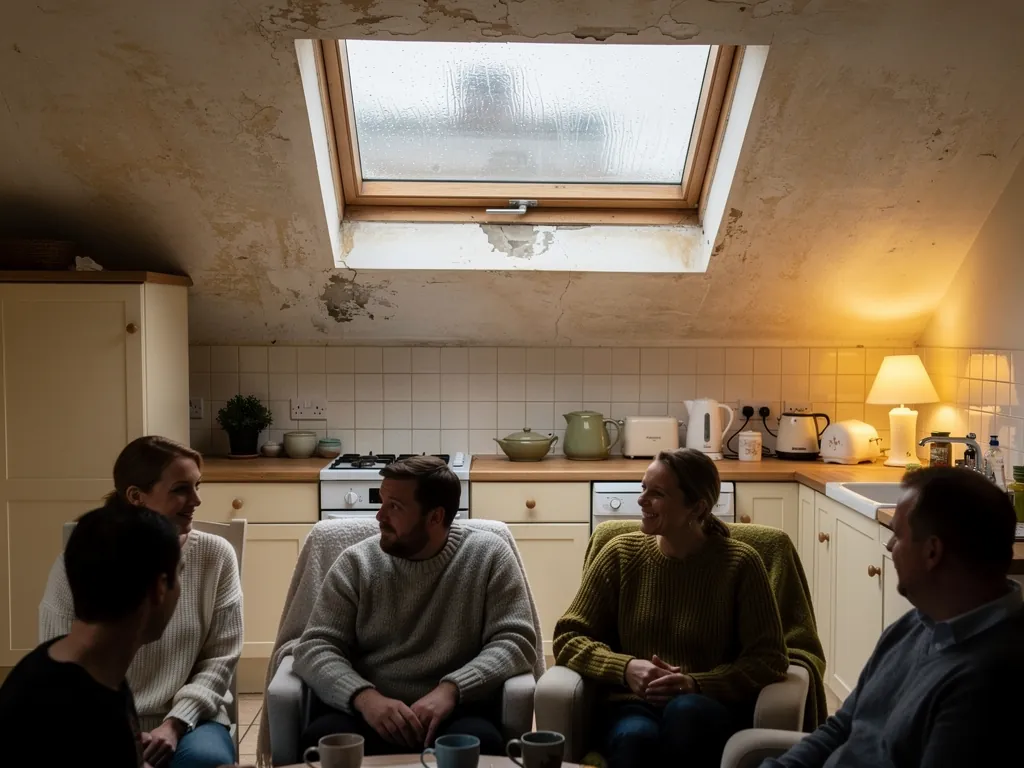
Everything that goes into a misted rooflight replacement
01Why it fogs
Why a sealed glass unit goes cloudy between the panes
A misted rooflight is a glass unit whose seal has given up. Once the seal goes, damp air gets between the panes and the unit can no longer be put right. The answer is a new unit, or a new rooflight.
Look at the edge of any double glazed rooflight and you will see a thin frame of metal or composite running round between the two sheets of glass. That is the spacer. It holds the panes a fixed gap apart, and it carries a drying agent (a desiccant) that soaks up any trace of moisture trapped when the unit was made. Around the outside of the spacer sits the seal, a layer of sealant that bonds glass to spacer and keeps the room's air out of the gap. The gap itself is filled with argon, a heavy, inert gas that slows heat moving across.
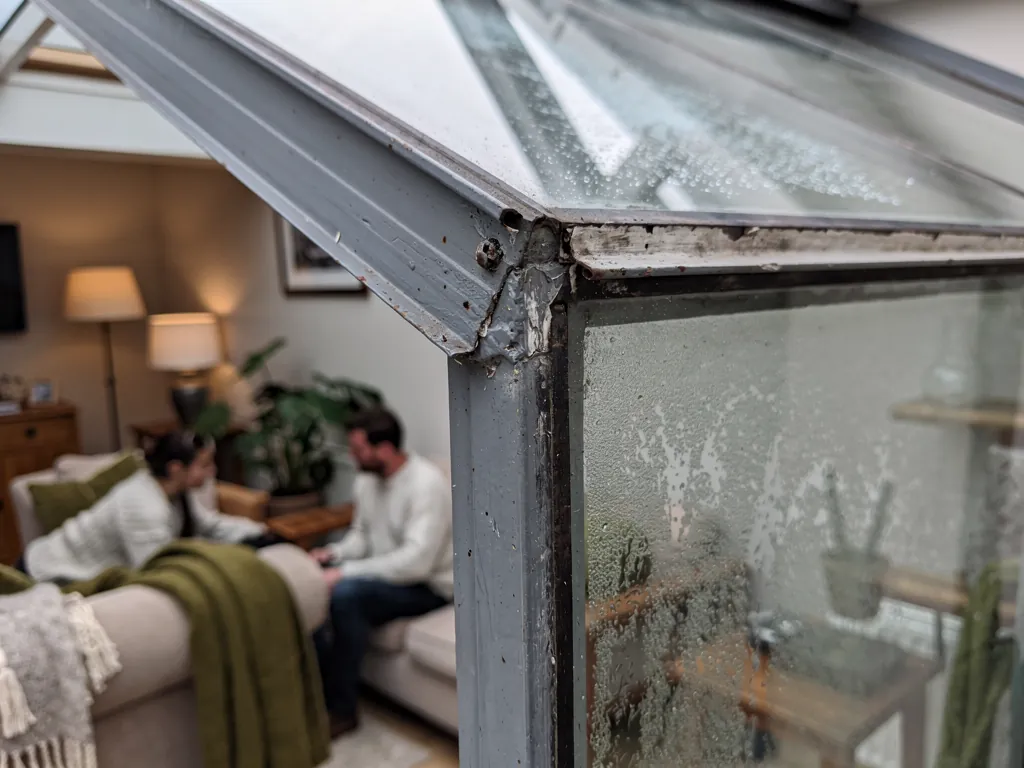
That is a sealed unit. It is meant to stay closed for good. When it does, you never think about it. When the seal weakens, the story changes. Moist air creeps in, the desiccant fills up, and once it can hold no more, the water has nowhere to go. It condenses on the cooler pane as a milky haze, droplets or a ghostly line of mineral staining. The argon leaks out as the damp comes in, so the unit also insulates worse than it did.
Our guide to why rooflight glass mists goes through the mechanism in more depth. In brief, glass does not mist from the outside in. It mists because the factory seal has lost its grip, and a closed unit cannot be opened, dried and closed again.
Why the seal gives up
Sealant is a flexible material, and a rooflight asks a lot of it. A pane facing the sun swings through a wide range of temperatures between a frosty morning and a bright afternoon. The glass expands and shrinks, the sealant stretches with it, and over the years it tires. Ultraviolet light, standing water on a shallow roof and a poor original fit all speed that along. A unit that was stressed when it was installed, perhaps by sitting on a twisted frame or by sitting in a puddle on a flat roof, fails sooner than one that was set square and left to drain.
02Diagnosis
Glass failure or frame failure: telling the two apart
Not every cloudy or dripping rooflight has a failed sealed unit. The first job is to find out whether the glass, the frame, the kerb or the roof around it is the problem, because each needs a different replacement.
A failed unit has a very particular look. The haze is trapped between the two panes of glass and sits in the same place whatever the weather. You cannot wipe it from either side. If you look along the edge of the glass, you may see a faint tide line or a rainbow-coloured film. All of that points to the glass.
Trouble in the frame or the kerb looks different. Damp patches on the plaster lining around the opening, stained or flaking paint on the reveal, black spotting along the edge of the frame, a soft or darkened timber upstand, or water marks that run down from the corners of the opening all say the problem sits around the glass, not in it. The glass can be perfectly clear and the frame can still have reached the end of its life.
Our guide to the signs a rooflight has failed lists the warning signs room by room. Here is the quick split between them.
| What you see | Points to | Usual route |
|---|---|---|
| Cloud or droplets between the panes, same all day | Failed sealed unit | New sealed unit |
| Wipe-clear mist on the room side only | Room humidity and cold glass | Warmer glazing, better airflow |
| Stained plaster or dark marks round the opening | Frame, kerb or roof junction | Whole rooflight, often with the upstand |
| Cracked, crazed or warped plastic dome | Dome at end of life | Whole unit |
| Frame twisted so the sash does not close | Frame movement | Whole rooflight |
On the survey we look at both sides of the roof opening, run a hand over the lining, check how the frame sits and how the kerb meets the roof, and tell you plainly which of those columns you are in. If the glass is the only problem, we say so, and we do not sell you a bigger job.
03The choice
New sealed unit or a whole new rooflight
There are two replacement routes. One swaps the glass and leaves the frame. The other takes out frame and glass together. The right one depends on what condition the frame is in, and the paperwork differs between them.
Swapping the sealed unit alone is the lighter route. The old glass comes out, a new unit made to the exact size goes in, and the frame stays. It makes sense when the frame is sound, square and still closes properly, and when the existing frame can take a modern, thicker, warmer unit. It is also the quicker visit.
Replacing the whole rooflight is a bigger job, and a more thorough one. Frame, sash and glass come out and a new rooflight goes into the same opening, bedded on a properly insulated upstand. It is the right move when the frame is tired, when the glazing is old and thin, when the opening has been cold for years, or when you want a different performance from the unit altogether.
Sealed unit only
Frame stays. Best when the frame is sound and square, the glass is the only fault, and the frame is deep enough for a modern unit. Not a notifiable job under the Building Regulations.
Whole rooflight
Frame and glass both replaced. Best when the frame is worn, the opening is cold or stained, or the old unit was thin. A controlled fitting under Part L, so it is notifiable and the new unit must meet the limiting U-value.
Our guide to sealed unit or whole rooflight sets out how to weigh the two. We cover the question on the day of the survey too, with the frame in front of us.
04Part L
What the Building Regulations say about each route
Replacing only the glass is not notifiable. Replacing the whole unit is. We deal with the notification, so you do not need to chase the council or a certificate.
Part L of the Building Regulations covers the conservation of fuel and power. Under it, a rooflight counts as a controlled fitting, which is the regulations' term for building elements such as windows, rooflights and external doors that have to meet set energy limits. Put in a new controlled fitting, and you have done notifiable work.
That is the dividing line. Take out the frame and the glass together and what goes in is a controlled fitting. The work has to be notified to Building Control, and the new unit has to meet the limiting U-value in force for replacement rooflights. A U-value measures how fast heat passes through a material, in watts per square metre per degree of temperature difference (W/m²K). A smaller number is a better result. Our answer on whether replacing a sealed unit is notifiable explains why a sealed unit on its own sits outside that, but a new frame does not.
Where the job has to be notified, Building Control hears from us, and the fitting is built to current Building Regulations. If you want the wider picture on rooflights and the regulations, our page on whether rooflights need Building Regulations covers it. For the planning side of putting a rooflight in a roof, see the skylight planning permission guide. If you are replacing like for like in the same opening, planning questions usually do not arise, but the guide shows where they might. Listed buildings are different and always need consent, so check with the council first.
- Sealed unit alone: not a controlled fitting, so no notification is needed
- Whole rooflight: controlled fitting under Part L, notifiable
- Whole rooflight: must meet the limiting U-value for replacement rooflights
- We make the Building Control notification where the work needs one
- Listed building: listed building consent is always needed, whichever route you take
05Warm glazing
Using the replacement to make the room warmer
A failed unit is a chance to put in something better than what came out. The old glass was probably made to a lower standard, and today's warm glazing holds the heat in far better.
Most older rooflights are plain double glazing, often with an aluminium spacer round the edge and air in the gap. Aluminium conducts heat very well, which is exactly what you do not want at the edge of a pane. The cold runs through the metal and chills the glass near the frame. That is where you tend to see condensation first and where a draught-like chill comes off the glass in winter.
The modern replacement works on several fronts. A low-emissivity coating (low-E) is a nearly clear metal film on one face of the glass, and it sends warmth back towards the room. Argon in the gap slows the heat moving across. A warm-edge spacer, made from a composite that does not conduct heat like metal, cuts the cold bridge at the perimeter. Warm-edge glazing is standard on everything we fit. Our page on energy efficient rooflights explains the options, and the page on warm-edge spacers and thermal breaks goes into how that edge detail works.
Triple glazing is the step beyond. A third pane and a second gap push the figure lower again, at the cost of weight and a thicker unit, so it is worth discussing before you decide, particularly when the frame has to carry it. Our warm specification page shows how we build a rooflight for heat as well as light.
- 1.4W/m²K, a good double glazed rooflight with low-E and argon
- 0.8W/m²K, a strong triple glazed centre-pane figure
- 2panes in double glazing, with one gap to fill with gas
- 3panes in triple glazing, with two gaps and a heavier unit
These are standard, general figures for the type, not a promise for any one rooflight. Your own quote states what we propose to fit.
06Old domes
Old plastic domes and early rooflights
Plastic domes do not mist in the same way glass does, but they age, yellow, craze and lose their grip. Where one has failed, a whole new unit is the route.
Many flat-roofed extensions across Basildon, Laindon and Pitsea were built with a plastic dome rooflight over the kitchen or hallway. A dome is a moulded acrylic or polycarbonate bubble, often a double skin, sitting on a small kerb. It lets light in, and it does little for heat. Over decades the plastic yellows in the sun, goes brittle and may crack along the fixing line. Moisture can also work in between the two skins, leaving a stained, cloudy dome that is the plastic cousin of a misted glass unit.
There is nothing to put right in a sealed plastic dome. The sensible move is to take it out and fit a new rooflight in its place. That could be a flat glass rooflight on a proper insulated upstand, a new, better dome, or, on a larger opening, a lantern. Our pages on flat roof rooflights and roof lanterns show what each does for a room.
Early pitched-roof rooflights of the same era are similar. Thin single glazing in a timber or steel frame, a rusted or rotted frame, and an old unit that has misted are all common reasons to go for the whole unit. Tell us what is up there and we will look at it on the survey.
Old plastic dome
Thin skins, cold edge, yellowing and crazing with age. Replaced as a whole unit, usually with a glass rooflight on a warmer kerb.
Modern glass unit
Low-E, gas-filled and warm-edge. Stays clear, holds heat in and gives a clean, level finish to the ceiling opening.
07Pitched roofs
Roof windows and branded units
Roof windows from makers such as VELUX, Keylite and Fakro are built as a complete unit. What can be replaced separately depends on the make and on how the glass is held.
A roof window is a hinged or pivoting window set into a pitched roof, usually in a loft room, a landing or a dormer-less bedroom. Most are made by one of a handful of well-known manufacturers. The glazing is bonded and held in place in ways that differ from one range to the next, and on many models the pane is part of a sash that is made as a single piece.
That is why the question comes up so often. Our short answer on whether you can replace just the glass in a VELUX explains it. In some cases a replacement pane or sash is available for the model. In others the neat and lasting route is a new roof window. Our roof windows and VELUX windows pages show what is possible and how the fit works.
A new roof window is also a chance to change the specification: a warmer glazing build-up, a better flashing kit and a properly insulated reveal. If the original has been up there for a long time, it may be a model the maker no longer lists, in which case an exact like-for-like unit may not be on offer, and a modern equivalent is the answer. We measure the opening, check the rafter spacing and tell you what will fit.
08Clearing it
Can a misted pane be cleared, drained or dried out
No. Once moisture is inside a sealed unit, the unit has failed. Nothing you do from outside will bring the glass back to clear for long.
This is the question we hear most from anyone who has noticed the first haze. Surely there is a quick clean, or a way to drill a tiny hole and dry the gap? It is a fair thing to wonder, and the truth is that nothing holds. A small vent hole breaks the gas fill and lets the room's air in and out for good. A clean from outside does nothing, because the cloud sits between the panes. Even where a cloudy unit looks clear for a while, the cause is still there and the haze returns.
We go through this in full in our answer on whether misted rooflight glass can be cleared. It is also why this page is about replacement, not a stopgap. The seal failed. The only lasting step is a new sealed unit in the existing frame or a new rooflight.
There is a different problem that is easy to confuse with this one. If your rooflight collects water on the room side and drips in cold weather, that is condensation on the inside of the glass, and the glass may be perfectly sound. We cover that in why a rooflight drips in winter. Our flat roof page on condensation on flat rooflights looks at it from the flat roof side. Warmer glass is the cure in both cases: a unit with a warm edge and a coated pane stays closer to room temperature, so the moisture has less cold glass to settle on.
If the cloud is between the panes, no amount of cleaning will bring it back. The seal has gone, and a new unit is the answer.
09Fitting day
What happens on the day we replace your rooflight
One team, one visit for most replacements, with your floors and furniture covered before anything comes out. Here is the order of play.
It starts with the survey. We visit, look at the frame, the glass, the kerb and the lining, and measure up. The quote is free and written, and it says which route we recommend and why. Where the whole rooflight is going, a made-to-measure unit is ordered, which takes a little time. A sealed unit is also made to the exact dimensions of your frame, so we measure the rebate (the recess in the frame that the glass sits in) with care.
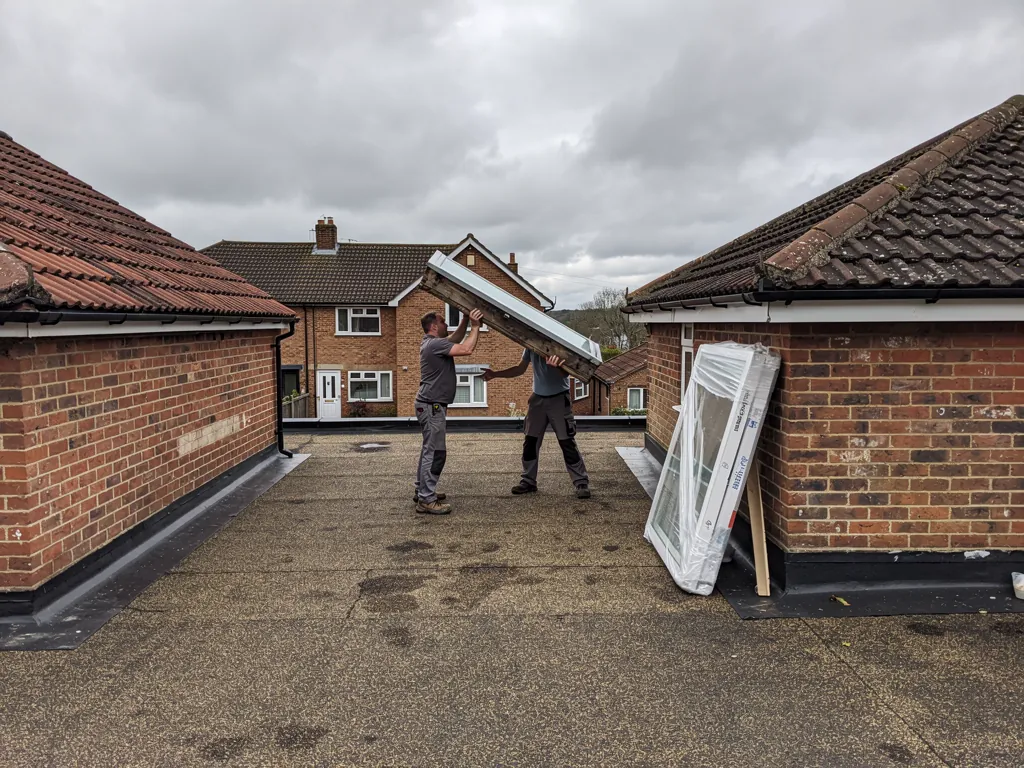
On the day, the same team who surveyed you arrives with the new unit. You do not meet a stranger on the roof, and you are not handed from one gang to the next. Floors, units and furniture below the opening are covered and protected before the work begins, and the room is left clean at the end of the day.
- We protect the floor, furniture and anything under the opening, and clear access to the room.
- The old glass, or the old frame and glass together, is taken out and lifted away.
- The opening, the kerb and the frame seat are checked and made ready for the new unit.
- The new sealed unit or whole rooflight is fitted, levelled and secured, with insulation closed round it.
- The lining and reveal are tidied and finished so the room is ready to use.
- We clean up, show you the result and explain the paperwork, including the Building Control notification where the work needs one.
A single rooflight is normally a short visit. A large lantern or several units across a roof take longer, and we say so in the quote. Because we do not rely on dry weather for the interior, you are not left with a hole above the room longer than necessary: the new unit is ready to go in before the old one comes out.
10What it costs
What decides the cost of a replacement
The cost depends on six things. We quote after a survey so the number reflects your roof, not a guess. Our costs page gives the broader picture.
Anyone who tells you a price for misted rooflight replacement without seeing the roof is guessing. What a job costs depends on what we find and what you choose. The factors below are the ones that move the figure the most.
What moves the cost of a replacement
- Route
- A sealed unit alone is a lighter job than a whole rooflight, which includes the frame and the Building Control notification
- Size
- A bigger pane means more glass, more weight and sometimes more people on the roof
- Glazing
- Double glazing, triple glazing, laminated or coated glass, and the spacer type all change the unit price
- Frame and finish
- Aluminium, uPVC or timber, and a standard or special colour
- Access
- A single-storey flat roof is easier to reach than a steep roof three floors up
- Condition of the kerb
- A sound upstand can stay. A softened or poorly insulated one is better replaced while the roof is open
Several rooflights replaced in one visit can be more economical than one at a time, since the access, protection and notification are shared. If you have a few units that are all showing their age, tell us at the survey and we will price them together.
11Afterwards
Aftercare, and how long the new unit should last
A new sealed unit should outlast the ones before it, as long as the seal is kept dry and the frame stays sound. We stand behind the work with a 10-year workmanship guarantee.
How long does a rooflight sealed unit last? There is no single number, because the answer depends on the maker, the glass, the aspect of the roof and the original fit. Our answer on how long rooflight sealed units last gives the honest range and what shortens it. The things you can control are small, and they cost nothing.
- Keep the glass clean on both faces with warm water and a soft cloth, and avoid strong solvents near the edge seal.
- Leave the room's ventilation working, so moist air does not hang about under the glass.
- Check the lining and reveal for stains once a year, so any change shows early.
- Avoid fixing anything to the glass or frame, and do not paint over the seal.
- Keep blinds and film products to those made for rooflights. Our note on blinds for warmth shows what suits.
Our 10-year workmanship guarantee covers the fitting itself. If you notice anything about the unit once it is in, such as a change at the edge of the glass or a stain on the lining, get in touch and we will look at it. The one team who fitted it comes back, not a call centre.
Ready to find out which route suits your rooflight? Get in touch and we will survey for free, then put in writing exactly what the glass needs. You can also look through the full range of services we fit, and the misted and failed rooflights section holds all of the guides and answers above in one place.
Misted glass: what can be saved and what cannot
Is a misted rooflight a problem, or only an eyesore?
Both. The haze shows that the seal has failed and the gas fill is gone, so the glass insulates less than it did. The room under it is harder to heat, and the cold edge can bring condensation round the frame.
Can you replace just the glass?
Often, yes. If the frame is sound, square and deep enough, we fit a new made-to-measure sealed unit in it. If the frame is worn, or the pane is part of a sash that cannot be taken apart, we replace the whole rooflight.
Will I need Building Control involved?
Not for a sealed unit on its own. A whole rooflight counts as a controlled fitting under Part L, which makes it notifiable, and the notification is something we take off your hands.
Can the new glass be warmer than the old?
Yes, and it usually should be. Our units use low-E coatings, argon fill and warm-edge spacers as standard, and triple glazing is available when the frame can take it.
Do you replace old plastic domes?
Yes. A yellowed or cracked dome comes out as a whole unit, and we fit a new glass rooflight, a better dome or a lantern, depending on the room and the size of the opening.
How do I get a quote for misted and failed rooflights in Basildon?
Contact us for a free survey. We look at the glass, frame and kerb, tell you which route fits, and send a written quote with no pressure to go ahead.