Everything that goes into an opening rooflight
01Why open
Why a rooflight that opens is worth having
A fixed rooflight brings light in. An opening one also lets stale, steamy or overheated air out, and in a room that fills with cooking heat or shower steam, that second job matters as much as the first.
Warm air rises. Every home in Basildon, Wickford and Billericay already runs on that simple fact: the hottest air in a room sits against the ceiling. A rooflight that opens puts a way out in exactly the place where that air collects. Open it a little and the warm, damp or stuffy air drifts up and away, while cooler air is drawn in through a door or window lower down. No fan needed, no noise, and nothing to clean.
That is why an electric opening rooflight is one of the most useful things you can add to a skylight scheme. It is also why this page exists. Opening skylights are not a different kind of glass roof. They are a rooflight with a moving sash, a set of hinges, a motor or a pole, and a sensible way to control it. Done well, the room is bright, the air stays fresh, and the heat stays in when you want it to.
Electric or manual: the plain difference
A manual opening rooflight moves by hand. You reach it with a pole, a handle or a winder, or you stand on a chair and push. An electric one has a small motor, called an actuator, that pushes the sash open and pulls it shut at the touch of a switch, a remote or a sensor. Both are real options and both suit certain rooms. The rest of this page helps you pick, and explains what has to happen on the roof, in the ceiling and in the wiring for either one to work properly.
If you want the wider picture of what we install, our services page lists every type of rooflight and skylight, and the skylight or rooflight guide explains the two names.
- Steam and cooking heat leave through the top of the room instead of settling on the ceiling
- Summer heat can be let out on warm evenings without opening a window at floor level
- Fresh air arrives without a draught across the people sitting below
- A rooflight too high to reach becomes something you can use every day
- The glass still lights the room whether the sash is shut or open
02Right rooms
Where an opening rooflight helps most
Opening is worth paying for in rooms that make moisture or heat, and in places a window cannot reach. Elsewhere, a fixed rooflight is simpler and a little warmer.
Think about what each room does to the air. A kitchen throws out steam, grease and cooking heat. A bathroom or shower room is damp for twenty minutes at a stretch. A stairwell is the chimney of the house: warm air from every floor climbs it and stops at the top. A loft room under a pitched roof gets hot in summer because there is nothing above it but tiles and a thin layer of air. In each case the best place to let the bad air out is the highest point, and that is where a rooflight sits.
Kitchens and kitchen-diners
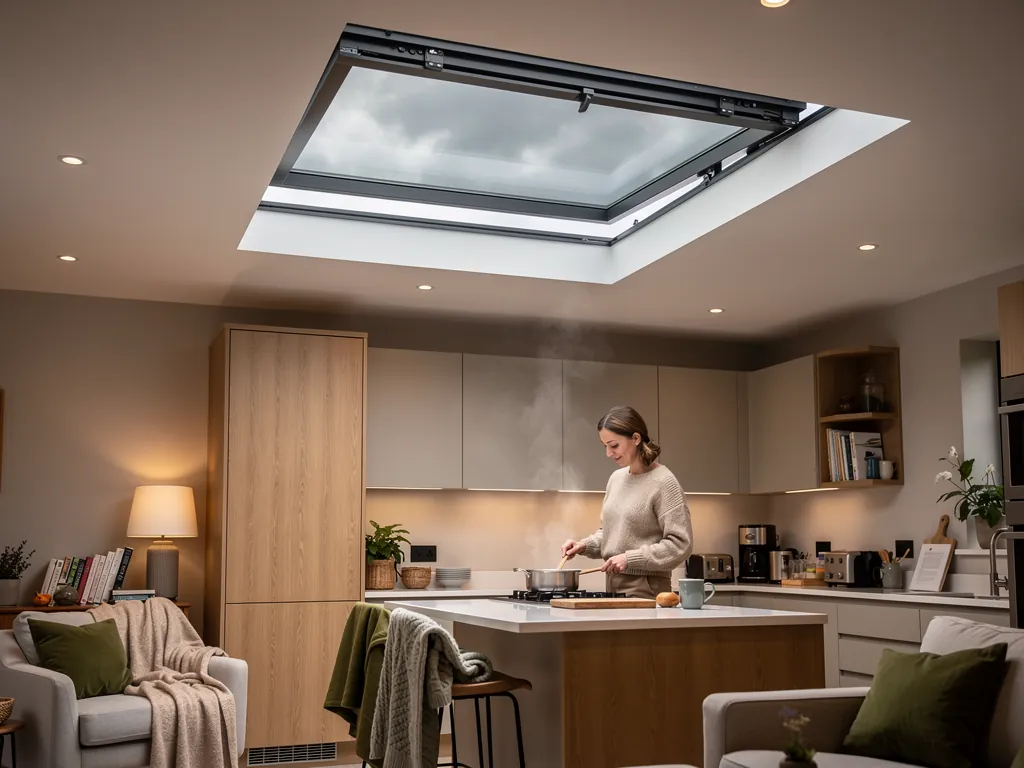
The kitchen-diner on the back of a 1970s semi is a classic. The extension is bright enough, but the hob and oven fill it with warm air and the cooker hood only catches part of it. An opening rooflight over the cooking end lets that air leave. In a room with a roof lantern, an opening vent in one panel does the same job. Our roof lanterns page covers that option.
Bathrooms and shower rooms
Many bathrooms have a fan and a small window, and the mirror still mists. A rooflight that opens above the shower lets the steam go straight up. Because the room is small, a manual pole or a hand winder may be all you need, and a motor is a bonus if you want to open it without getting wet.
Stairwells, landings and lofts
A stairwell rooflight is usually out of reach, so electric opening comes into its own there. Without it, the glass never moves. With a wall switch at the bottom of the stairs you can vent the whole house on a hot night. A loft conversion with a roof window is a similar case, and our roof windows page explains those and how they open.
| Room | What it needs from the opening | Best control |
|---|---|---|
| Kitchen | Let out hob heat and steam | Wall switch or remote |
| Shower room | Clear steam quickly | Pole, winder or switch |
| Stairwell | Vent the whole house | Wall switch at the foot |
| Loft room | Take off summer heat | Remote or sensor |
| Dining room | Fresh air on warm evenings | Remote |

03Motors
Electric actuators: what the motor does
An actuator is a small motor with an arm. It pushes the sash up to open and pulls it down to close, and it holds the sash in place once it stops.
You will meet two kinds of actuator on rooflights. A chain actuator is a slim motor with a chain that unwinds from the housing to push the sash and rewinds to pull it shut. It is compact and neat, and it suits sashes that open a modest amount for ventilation. A spindle or push-pull actuator is stronger, with a rigid rod that does not flex, and it suits heavier sashes or ones that open to a wider angle. Your installer chooses between them based on the size and weight of the sash and how far you want it to open.
Many actuators for rooflights run on low voltage, commonly 24 volts DC. A small box called a transformer, or a power supply, steps the mains down to that level. Some systems run on mains voltage directly. Either way the actuator is wired back to a switch or controller, and the whole circuit has to be installed safely.
Stroke, speed and closing force
Three numbers describe an actuator. The stroke is how far the arm travels, which sets how wide the sash opens. The speed is how fast it moves, and a slow, steady opening feels better than a jerk. The force is how hard it pulls the sash shut, which matters because the sash has to compress the seal and lock tight to keep the heat in. A good actuator pulls the sash firmly onto its seal and holds it there.
Manual opening, when it is enough
A manual rooflight opens by one of three routes. A hinged sash with a handle you can reach, a long pole that hooks into an eye on the frame, or a winder, which is a crank with a rod that pushes the sash open a few centimetres at a time. Poles suit ceilings up to about the height of a normal room. Winders are neater, because the crank sits on the wall or ceiling and does not need to be stored in a corner.
The downside is that you have to be there. If you leave the house, you either leave it shut or leave it open and hope the sky behaves. The other downside is height. A rooflight over a two-storey stairwell, or over a double-height part of an extension, is simply out of reach of a pole. That is where an electric opener makes the difference between a vent you use and a vent you ignore.
Lighter on parts
A manual rooflight, when shut, has fewer parts to keep warm. There is no actuator in the frame, no cable running through the lining and no motor housing. That makes it a clean fit for rooms where you only need the vent a few times a year, such as a utility room or a spare bedroom.
Chain actuator
Slim and discreet. Suits a small to medium sash that opens for ventilation. The chain is flexible, so it relies on the frame and hinges to guide the sash.
Spindle or rod actuator
Bulkier, with a rigid arm that can push and pull. Suits heavier sashes, wider openings and glass-heavy units. It gives a firmer close, which helps the seal.
04Controls
Switches, remotes, sensors and the smart home
How you open the rooflight matters as much as the motor. The best control is the one you will actually use, and a rain sensor is the one worth having whatever else you pick.
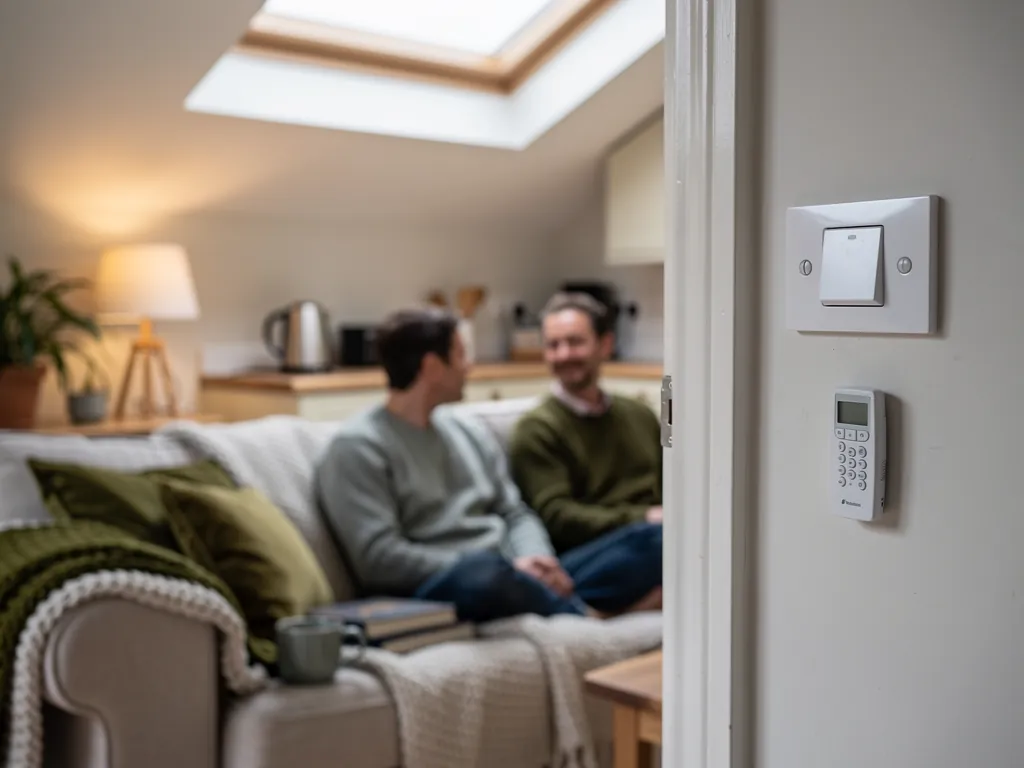
The simplest control is a wall switch. It has three positions: open, close and stop, and it is wired back to the actuator. It is cheap, it works every time and nobody has to find a remote. A handheld remote or a wall-mounted wireless panel does the same without a wire from the switch to the motor, and it can run several rooflights at once. A keypad or touchscreen controller can be set to open each rooflight by a set amount or at set times.
Some systems connect to a phone app or a smart-home hub. That lets you open the rooflight from the sofa or close it from the car if you spot a dark cloud. It is a nice extra, but it adds software that has to keep working. If you want it, we can specify a controller that works from a plain wall switch too, so the rooflight is never stuck behind an app.
Rain sensors
A rain sensor is a small unit mounted on the roof next to the rooflight. It detects the first drops of rain and tells the controller to close the sash. It is the single most useful addition to an electric rooflight, because it protects the room when you are out or asleep. Our guide to rain sensors and rooflight controls goes through how they work, where they sit and how to set them up.
Timers and temperature sensors
A timer can shut the rooflight at night. A temperature sensor can open it when the room passes a set point and close it when it cools down. Neither replaces your own judgement, but they are handy in a glazed extension that heats up fast on a sunny day.
- Wall switch: three buttons, wired, the most dependable choice
- Handheld remote: no wire from the switch, runs several rooflights
- Rain sensor: closes the sash when rain starts, whoever is home
- Timer or thermostat: opens and closes by the clock or the room temperature
- Phone app: handy extra, best alongside a plain switch
05Wiring
Wiring, the electrician and Part P
An electric rooflight needs a power supply, a cable run and a switch. That is electrical work, and it must be done and tested by a qualified electrician.
Part P of the Building Regulations covers electrical safety in homes. In general terms, it means certain electrical work in a dwelling has to be designed, installed, inspected and tested to a recognised standard, and some of it has to be notified to Building Control. Whether a particular job is notifiable depends on what it involves, such as whether it adds a new circuit or only extends an existing one, and where it is in the house. Work in a bathroom, for instance, carries tighter rules because of the water. Do not guess: ask the electrician who is doing the job, and ask us.
Our fitting team opens the roof, sets the rooflight, makes the kerb and lining, and seals it all. The wiring is a separate trade, and a qualified electrician does it. We work out where the actuator, transformer and sensor will sit before the roof is opened, so the cable runs are planned instead of improvised. If the electrical work is notifiable, the registered electrician certifies it through their scheme, and we notify the rooflight work. For the short version, read do electric rooflights need an electrician.
Where the cable goes
The cable has to get from the rooflight to a supply and to the switch, and it should not spoil the finish or the insulation on the way. In a new extension, it is easy to run before the ceiling is boarded. In an existing room, it may go through a stud wall, along a ceiling void or inside a small trunking. A low-voltage cable is thin, so it is easier to hide than a mains one, but it still needs to be protected, clipped and kept clear of heating pipes.
- We agree where the switch, transformer and any rain sensor will sit.
- The electrician runs the cable and fits the power supply before the lining goes in.
- We fit the rooflight and connect the actuator to the cable run.
- The electrician tests the circuit and the controls, and issues the paperwork.
- We set the stroke, check the close against the seal and show you the controls.
06Staying warm
Keeping the heat in when the sash is shut
An opening rooflight has a joint that a fixed one lacks, between the sash and the frame. That joint is where heat can slip out, so the seal and the build-up around it have to be right.
A fixed rooflight is one piece of glass held in a frame. An opening one has a moving sash that sits in a fixed outer frame, and there is a gap between them closed by a seal. If the sash does not pull tight, or the seal is thin or crushed, air moves through that gap and a cold line shows up around the edge of the glass. That is a draught and a cold spot at once, which is exactly what you do not want over a sofa.
The answer is in the specification. A good opening rooflight has a compressible gasket all the way round, sometimes two of them, and a frame that is thermally broken, which means a layer of low-conducting material separates the cold outer metal from the warm inner side. The glass is a sealed double or triple unit with a warm-edge spacer, and a low-emissivity coating that sends warmth back towards the room. The actuator has to be strong enough to pull the sash fully shut and hold it there.
The kerb and the lining
The frame stands on a raised kerb or upstand. On a flat roof, that kerb is insulated so the cold does not travel through the timber into the room. Inside, the lining around the opening is insulated and sealed to the frame so warm air cannot find the gap. Our kerbs and upstands guide explains the build-up, and our warm specification page lists what we fit as standard.
Glazing choices for an opening unit
Double glazing is the standard choice and does the job in most rooms. Triple glazing adds a third pane and a second gap, which cuts heat loss further, but it makes the sash heavier, so the actuator, hinges and frame have to be rated for it. That is not a problem, it just needs to be planned. If the rooflight is in a cold room such as a north-facing bathroom, or a room you heat all day, the extra glazing is worth a conversation. Our guide to double versus triple glazed rooflights goes through the trade-offs.
The inner pane is usually toughened or laminated. Toughened glass breaks into small blunt pieces. Laminated glass holds together if it cracks, thanks to a plastic layer between the sheets. For a rooflight above head height in a bedroom or over a stair, laminated on the room side is a sensible choice. It is good practice, not a rule, and your surveyor can say what suits the room.
Glazing can also add some control over summer heat. A solar-control coating cuts how much heat the glass lets in, which helps a south-facing kitchen. The trade-off is slightly less light and a faint tint. Opening the rooflight does the rest.
What keeps an opening rooflight warm
- Glazing
- Low-E double glazing, or triple for the coldest rooms
- Edge seal
- Warm-edge spacer in every sealed unit
- Frame
- Thermal break between outer and inner metal
- Sash seal
- Compression gasket right round the opening
- Actuator
- Strong enough to pull the sash firm onto the seal
- Kerb and lining
- Insulated and sealed to the frame, no chilly band
For more on glass and what U-values mean, see energy efficient rooflights and rooflight U-values explained.
07Security
Security and safety of an opening rooflight
A rooflight on the roof is a much harder entry point than a ground-floor window. Even so, an opening one should lock firmly and open only as far as it needs to.
Break-ins are far more likely at doors and ground-floor windows, so a rooflight is not high on the list. A burglar would need a ladder or a climb across the roof to reach it, and a rooflight above a first-floor stair is even less likely to be a target. That said, a sash that opens can be forced, so a good one has a locking handle, a restrictor that limits how far it opens, or a motor that holds the sash shut against a push. Our short answer on whether opening rooflights are secure covers it.
Safe in use
A motorised sash closes with force. A well-built system senses an obstruction and stops. Keep hands, children and pets clear of the frame while it moves, and put the controls out of a toddler's reach. Wall switches are a good choice for that reason: they sit high and stay put.
Fire and smoke
An opening rooflight is not automatically a smoke vent. A vent used to clear smoke in a fire has to meet separate requirements and is wired to a smoke detector or control panel. Read the answer to can an opening rooflight be a smoke vent before you plan it that way.
08Power cuts
Power cuts, fixed rooflights and a manual override
An electric rooflight depends on power to move. Plan for the day the power goes, and decide whether you want a manual backup.
If the power fails while the rooflight is shut, nothing happens: it stays shut and the room stays warm. If it fails while open, the sash stays where it is until power returns, unless the system has a battery backup or a manual release. In a bedroom or kitchen, that could matter if rain arrives, so the question is worth asking at the survey. The full answer is on our power cut page.
A rain sensor still needs power to work, so a cut also silences it. A battery backup unit, which is a small sealed battery inside the control box, can close the sash if the mains fails. Some systems also have a hand crank or a release you can use from the room. Not every model has one, so it is a specification choice to settle before you order.
Turning a fixed rooflight into an opening one
People ask whether an existing fixed rooflight can be motorised or made to open. Sometimes the answer is yes, but usually the frame is designed as either fixed or opening, so the practical route is a new rooflight. Our answer on making a fixed rooflight open explains why, and our fixed versus opening flat rooflights guide sets out the choice. When an old rooflight is being replaced anyway, replacing an old rooflight shows what is involved.
Power fails while shut
Nothing changes. The sash stays closed on its seal and the room stays warm and dry.
Power fails while open
The sash stays where it is until power returns, unless a battery backup or manual release closes it.
09Rules
Planning permission and Building Regulations
Fitting an opening rooflight is usually allowed without planning permission on a house, but the Building Regulations still apply, and the details depend on your property.
For planning, most rooflights on a house fall under permitted development, under Class C. That holds when the rooflight stands out from the roof slope by 150mm at most and its top stays below the roof's high point. A side-facing rooflight has to be obscure glazed and non-opening below 1.7 metres from the floor. Class C does not cover flats or maisonettes, and a listed home needs listed building consent in every case. A conservation area does not by itself remove permitted development, but an Article 4 direction can, so check with the council. Our skylight planning permission guide goes through it, and the government's own advice is at Planning Portal.
Building Regulations are separate. A brand new rooflight, frame and glass together, must be notified as a controlled fitting under Part L, which covers energy saving. Replacing only a sealed unit is not. Ventilation is covered by Part F, and an opening rooflight can contribute to that, but it does not replace the extract fans some rooms need. Electrical work falls under Part P, as above. Where notification is required we make it to Building Control, and all our fitting meets the Building Regulations now in force.
| Question | Where to look |
|---|---|
| Do I need planning permission? | Class C and your property type, checked with the council |
| Is the fitting notifiable? | Part L, for a whole new rooflight |
| Is the wiring notifiable? | Part P, depends on the electrical work |
| Does it count as ventilation? | Part F, may contribute but not replace fans |
10Ventilation
Using it well: fresh air without losing the heat
An open rooflight lets heat out as well as steam, so the skill is in opening it for the right length of time.
In winter, a few minutes of open rooflight after a shower or cooking clears the damp air without chilling the room. Opening it wide for an hour does the opposite: you heat the sky. Short, purposeful bursts are better than leaving it ajar. In summer, the best time to open is the evening and early morning, when the air outside is cooler than the air in your room. Open the rooflight, open a low window on the other side of the house, and the warm air draws up and out.
Our guide to ventilating a room with opening rooflights goes deeper on the airflow. For roof windows in loft rooms, top-hung versus centre-pivot roof windows shows how different sashes open. And if you are choosing a blind to go with the opening unit, blinds for warmth is a good read.
- Short bursts after showers and cooking, rather than leaving the sash ajar
- Open in the evening on hot days, when outside air is cooler
- Pair the rooflight with a low window for a through-flow of air
- Close the sash in the morning if the day will be hot, to keep the cool in
- Keep any extract fan running where the room needs one
11Fitting day
What happens on fitting day, and what drives the cost
We survey first, quote in writing, and send one team for the whole job. Cost depends on a few clear things, and we explain them before you commit.
Everything starts with a free survey. We look at the roof, the room, the ceiling void and where power could come from, and measure everything. You get a written quote after that, with the controls and any extras spelled out. Floors and furniture are covered on the day, and the same team stays from start to finish. We open the roof, set the kerb, fit the rooflight and line the opening, while the electrician connects the actuator and controls at the right stage.
- Free survey and written quote, with controls and wiring routes agreed.
- Floors and furniture protected, then the roof opened and the kerb prepared.
- Rooflight set, sealed and insulated into the roof build-up.
- Lining fitted and the electrician connects and tests the controls.
- Handover: we show you the switch, remote and sensor, and tidy up.
What drives the cost
Size is the first factor. A bigger sash needs a stronger actuator and more glass. Glazing is the second, since triple costs more than double, and laminated costs more than toughened. Controls come next: a basic wall switch is far simpler than a rain sensor, a battery backup and a smart controller. Then the roof itself, the height of the ceiling, how far the cable has to run and how much making good is needed. Ask the quote to name the actuator, control, sensor and glass, so nothing is left open to change. For general market guidance, see our costs page.
12Aftercare
Aftercare, guarantee and next steps
A rooflight that opens needs a little looking after: clean seals, free moving parts and a controller that still does what you set.
Once a year, wipe the gaskets with a damp cloth so grit does not stop the sash closing. Check that the actuator moves smoothly and the sash seats firmly. Clear leaves and moss from around the kerb and keep the rain sensor clean, since a dirty one can misread. Test the switch and the sensor after a long dry spell, and check the batteries in any remote and backup unit.
We back our fitting with a 10-year workmanship guarantee, and our guarantee page sets out what it covers. If you are thinking of a rooflight in a room we have not talked about, our areas page lists the places we cover, and our guides and answers sections answer the common questions. Ready to start? Get a quote and we will arrange a free survey.
The best opening rooflight is bright, warm when shut, and easy enough that you use it every day.
Unsure about wiring, sensors and switches?
Are electric rooflights expensive to run?
No. An actuator only draws power while it moves, which is a few seconds each time. When the sash is still, the draw is tiny. The cost is in buying and fitting the system, not running it.
Can I open an electric rooflight by hand if the motor fails?
That depends on the model. Some have a manual release or crank, and some do not. Ask at the survey and we will specify one that suits the room.
Will an opening rooflight let heat out when it is shut?
Not if it is made well. A compression seal, a thermally broken frame, warm-edge glazing and an actuator that pulls the sash firmly shut keep the heat in. The kerb and lining are insulated too.
Does a rain sensor work in a power cut?
No, it needs power like the rest of the system. A battery backup can let the sash close if the mains fails. It is worth asking about if the rooflight is in a bedroom or kitchen.
Do I need planning permission for an opening rooflight?
Usually not on a house, if it meets the Class C limits. Flats, maisonettes, listed buildings and homes under an Article 4 direction are different, so check with the council. Our planning guide has the detail.