01Rain
What a rooflight rain sensor actually does
A rain sensor is a small, simple switch with one job: shut the glass when water lands on it. This chapter explains how it decides, and what it cannot decide for you.
An electric opening rooflight, which is a skylight with a motor that lifts or tilts the glass, is lovely on a warm morning. It is a lot less lovely when you are at work, the sash is propped open and a shower rolls in over the sofa. The rain sensor exists to close that gap.
Most sensors work in one of two ways. The first is a heated grid on the outside of the glass or frame. Raindrops bridge the gaps in the grid, the circuit changes, and the control unit tells the motor to close. A little heat in the grid dries it off afterwards so it does not read "wet" all day. The second is an optical sensor that watches for water drops on a lens. Both are cheap compared with the cost of a ruined ceiling, and both do the same job: send a close signal.
The important point is that the sensor itself does not move anything. It talks to a control unit, and the control unit talks to the motor. If either link is missing, the sensor is just a bit of decoration. When we survey a house we look at the whole chain, not just the sensor.
What it does not do
A rain sensor reacts after water touches it. It does not forecast. A light drizzle may need a few seconds to register, and a fast squall can wet the sill before the glass is shut. It also cannot tell the difference between rain and a neighbour with a hose, a garden sprinkler, or a bucket of water thrown over a flat roof. That is why where it sits matters as much as what it is.
02Placement
Where the sensor goes, and why it matters
The same sensor can work brilliantly or badly depending on where it is fixed. These are the placement rules we follow.
On many electric rooflights the sensor is built into the unit by the maker. VELUX, Keylite and Fakro all offer opening roof windows with rain sensing included in some ranges or available as an add-on, and the details differ from model to model, so we check the exact product before we promise anything. On a larger flat roof rooflight, the sensor is more often a separate item fixed on or beside the kerb, which is the raised insulated upstand the glass sits on.
A sensor built into the glass assembly gets the same rain the glass does. A separate one has to be put somewhere that matches. On a flat roof extension the best spot is usually on the top of the kerb or on the roof surface close to the rooflight, in the open, away from overhanging branches and away from the outlet of a gutter or downpipe. A sensor tucked under a fascia stays dry in a downpour and the glass stays open, so a sheltered spot is the commonest mistake.
- In the open, not under an eave, a canopy or a dense tree.
- On the same roof plane as the glass it protects, so it gets the same rain.
- Away from gutter outlets, downpipes and any run-off from a neighbouring roof.
- Where the cable can reach the control unit without a long exposed run.
- Reachable for a wipe-down, since leaves and bird droppings can cause a false reading.
03Controls
Choosing how you control the glass
A rain sensor is one input. You also want a simple way to open and close the glass by hand, and the right choice depends on the room.
Every electric opening rooflight needs some way to command it. The usual options are a wall switch, a handheld remote, a smartphone app, and a link to a wider smart home system. Each suits a different household, and the wrong one is a daily annoyance.
Wall switch
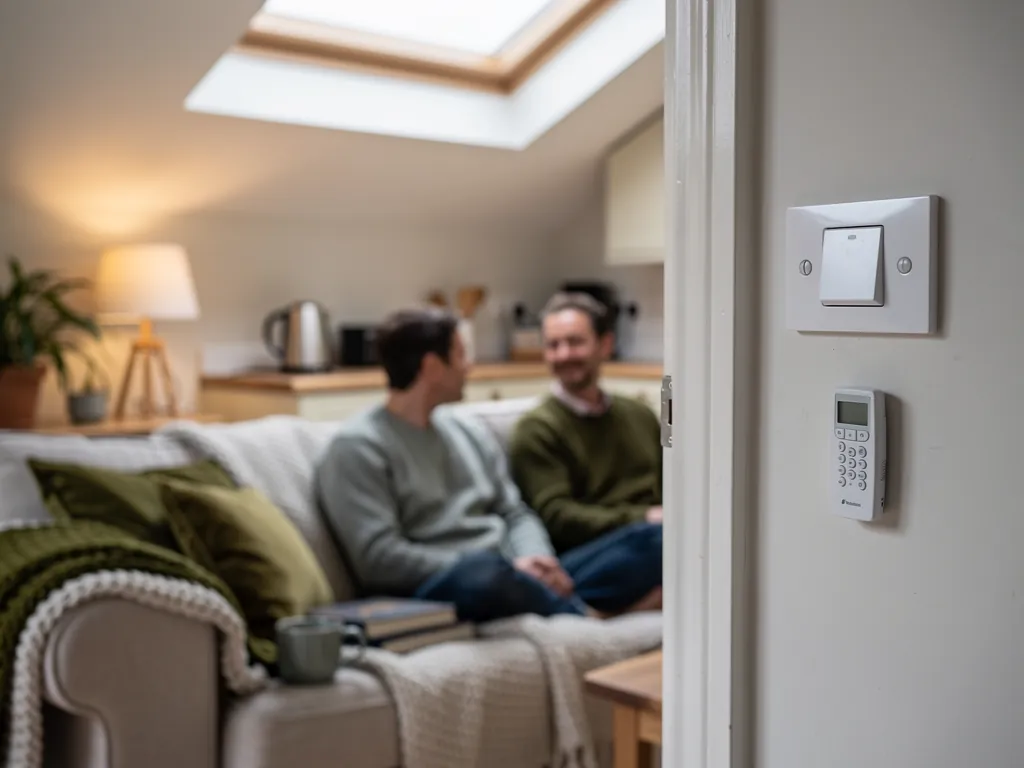
A rocker or push-button plate beside the door, wired to the control unit. It never needs charging, it never loses a signal, and a guest can work it without being shown. The cost is a cable run, so it is easiest to plan when walls are open for an extension or a loft conversion.
Remote or app
A handheld remote or a phone app speaks to the control unit by radio. It suits a room where chasing a cable would mean redecorating, and it lets you shut a rooflight from the sofa or the garden. The cost is a battery to change and a signal that can occasionally need a re-pairing.
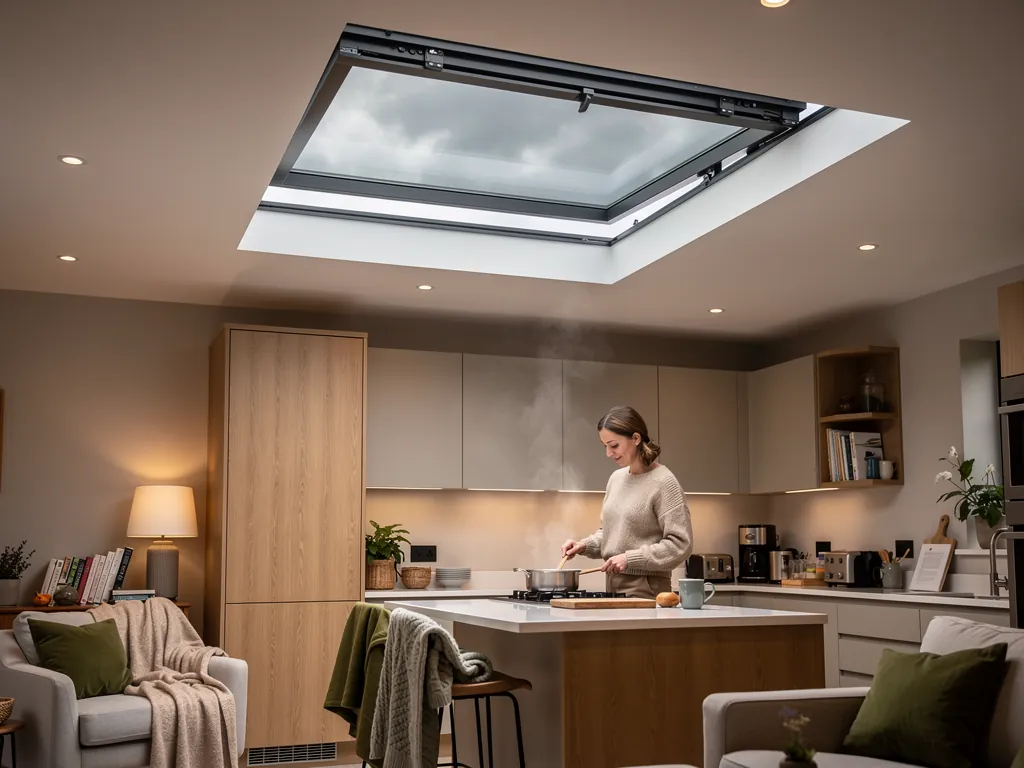
Where the budget allows, we suggest both on one rooflight: a wall switch as the dependable basic, and a remote as the convenience. A built-in rain sensor sits above both, so a wet roof closes the glass whichever way you last opened it.
Some controllers also close the rooflight on a schedule, for example every evening at ten, so it is never left open overnight by accident. That is a small feature that helps with security and heat loss alike. Our answer on opening rooflight security covers the locking side.
04Smart links
Timers, thermostats and smart home links
Beyond rain, a rooflight can respond to temperature, humidity and time. This chapter sorts the useful from the gimmicky.
Once there is a control unit, other sensors can plug into it. A room temperature sensor can open the glass when a south-facing kitchen climbs past a set point and close it as it cools. A humidity sensor can open a bathroom rooflight after a shower. Both work well because they do the sensible thing without asking.
The trap is letting automation fight your heating. A rooflight that opens at 22 degrees in May is a gift. The same rooflight opening because the room briefly warmed in a February sunbeam lets out heat you paid for, and then the heating has to win it back. We set thresholds for the season, and we explain the set points to you in plain words so you can change them yourself.
| Input | What it triggers | Where it helps most |
|---|---|---|
| Rain sensor | Closes the glass | Any rooflight left open while out |
| Temperature sensor | Opens or closes to a set point | South and west facing extensions |
| Humidity sensor | Opens after steam builds | Bathrooms, utility rooms, kitchens |
| Timer | Closes at a set hour | Overnight security and heat |
| Smart home hub | Scenes and voice commands | Homes already running one |
Smart home links are real and they work, but they are a layer on top of the basics, never a replacement. Rain closing, a hand switch and the heating should all work even if the wifi is down. We would rather you had a reliable switch than an impressive app with a long list of ways to fail.
05Power
The wiring, the supply and what happens in a power cut
Controls are only as good as the power behind them. Here is how the supply is arranged and what you can still do when it drops.
The motors on electric rooflights usually run at low voltage, often 24 volts direct current, fed from a small transformer, though some models run from the mains through a control box. Which one you have decides how the cable is routed and who may connect it. Our guide on whether electric rooflights need an electrician goes through the rules, and in brief anything touching the mains side should be done by a competent electrician, in line with Part P of the Building Regulations for electrical safety in dwellings.
A rain sensor needs a signal path to the control unit. Wired sensors are reliable and, once fixed, you forget about them. Wireless sensors save a cable run but have a battery or a small solar cell. We tell you which type is on your quote and where the battery sits.
When the power goes
If the power cuts out while the glass is open, the rain sensor cannot close it. Some systems include a battery back-up or a manual override, and some can be cranked shut by hand with a tool. We check and tell you which your model has before you buy, because it is the one question people forget to ask. The detail is in our answer on what happens to an electric rooflight in a power cut.
- Find out whether your rooflight has a battery back-up, a hand-crank override, or neither.
- Note where the override tool or the isolator switch is kept, and tell everyone in the house.
- Close the glass by hand before a planned outage or a long absence.
- If the rooflight has been left open and a storm arrives during an outage, shut it manually as soon as it is safe to reach.
06Warmth
Keeping the heat in with automatic closing
A rooflight that closes itself is a draught-stopper as well as a rain guard. This is the warm side of the controls.
Most people think of the rain sensor as protection for the floor. We think of it as protection for the heating bill too. An open rooflight on a winter afternoon is a hole in the ceiling, and warm air rises straight out of it. The same unit that shuts for rain can be set to shut at dusk, when the room starts to cool, so the heat you worked for stays in the house.
The closing seal matters as well. When the glass shuts it presses on a gasket, and the gasket needs to meet the frame evenly all the way round. A tight seal is what stops a draught at the edge. At installation we check the glass pulls fully home and that the frame sits on an insulated upstand or a properly lined opening, so there is no cold bridge, which is a path where heat leaks through the frame itself. Warm-edge glazing is standard on what we fit, and it keeps the edge of the glass from running cold and misting.
A rooflight that shuts itself when it rains or when the evening cools is doing two jobs for the price of one motor.
If you want the larger picture of how opening glass and heating work together, our guide to ventilating a room with opening rooflights covers what to open, when, and for how long.
07Fitting
What to expect when we fit rain sensing and controls
From survey to the last test, this is how the work runs and what we set up on a typical electric opening rooflight.
We start with a free survey and give you a written quote. At the survey we look at the roof, the room, the route for the cable and the right place for the sensor. Where the rooflight is a new fitting or a whole replacement, the work is notifiable under Part L of the Building Regulations as a controlled fitting, and we handle the Building Control notification. One team does the whole job, floors and furniture are protected, and the work carries our 10-year workmanship guarantee.
What we set up on a typical job
- Sensor
- Built in, or fixed in the open beside the kerb
- Control unit
- Sited where the cable run is shortest
- Hand control
- Wall switch, remote, or both
- Glazing
- Double glazed with warm-edge spacer as standard
- Closing test
- Wet the sensor, watch the glass shut fully
- Handover
- Override, set points and cleaning shown in person
The last step is the one we enjoy. We wet the sensor with a damp cloth and watch the glass close, then show you how to override it. If it does not close fully and evenly, we are not finished.
If you are swapping an older rooflight for a new electric one, our guide to replacing an old rooflight explains the steps and what the upstand needs.
08Looking after it
Day to day: testing, cleaning and sensible habits
A sensor you never check is a sensor you cannot trust. These small habits take a minute and keep the system honest.
Test the sensor now and then. Take a damp cloth or a splash from a spray bottle and touch it to the sensor on a dry day. The glass should close. If it stays open, tell us. Do this at the start of spring and again before winter, and always after a long dry spell when dust and pollen can coat it.
Keep it clean. Pollen, leaf mould and bird droppings can blind a sensor or keep it wet. A soft cloth and clean water is enough. Never use abrasive pads or strong solvents on the sensor surface, and keep ladders off the roof unless you have the right kit and know the roof can take the weight.
If you are away for a week, close and lock everything first. The sensor is a safety net, not the plan.
- 24volts direct current, a common motor supply on opening rooflights
- 1.7metres, the height below which side-facing roof windows must be obscure and fixed
- 150millimetres, the most a roof window may project beyond the slope under Class C
Will the sensor shut in time, and what if it fails?
Does every electric rooflight have a rain sensor?
No. Some models include one, some offer it as an add-on, and some do not have one at all. We confirm what your chosen rooflight includes at the survey, and we say so plainly on the written quote.
Can a rain sensor be added to a rooflight I already have?
Sometimes. It depends on the make and model, whether it has a control unit that accepts a sensor, and where a sensor could be fixed. We can look at it during a survey. If the motor and controller will not take one, we will tell you what a replacement would involve.
Will the sensor close the glass if the rain is very light?
It reacts when enough moisture touches it. A fine mist may take a moment, and a brief spot may not register at all. That is why we tell people not to treat it as a forecast, and to close the glass when they know rain is due.
Does a rain sensor stop condensation or heat loss?
No, it only responds to rain. Heat loss is handled by the glazing and the frame, and by a timer or a habit of closing the glass at night. Our answer on whether skylights make a room cold goes into that in more depth.
Is a rain sensor worth it on a small bathroom rooflight?
Usually yes, if the rooflight opens electrically and you are ever out with it open. Bathrooms are often left cracked for steam, and a sensor takes the worry out of leaving. For a rooflight you only open while you are in the room, you may not need one.
Where can I see the whole opening rooflight range?
Start at our electric opening rooflights page. It covers the options, and then the survey tells us what suits your roof and your room.