01Air
Why an opening rooflight is a good ventilator
Warm, stale air rises and an opening rooflight sits at the highest point of the room. This chapter explains why that makes it the best hole in the house to let air out of.
Ventilation is simply swapping stale indoor air for fresh outdoor air. Rooms need it for three reasons: to clear cooking and shower steam, to keep carbon dioxide and smells from building up, and to cool the place down when the sun has been on the glass all afternoon. An opening rooflight, which is a skylight whose sash lifts or tilts on a hinge or a motor, does all three well, because of one bit of simple physics.
Warm air is lighter than cool air, so it floats to the ceiling. When the highest opening in a room is a rooflight, the hottest and dampest air has an exit right where it collects. A side window can only let out the air that happens to drift towards it. A rooflight pulls the heat up and out. Builders call this the stack effect, after the way a chimney draws.
The effect needs a way for fresh air to come in lower down. Open a rooflight in a sealed room and not much happens. Open it with a door or a window cracked on the opposite side of the room and you get a steady, gentle flow through the whole space, without a gale.
Where it helps most
The rooms that benefit are the ones that overheat or steam up: a south-facing kitchen-diner with a lantern, a loft bedroom under the slope, a landing above the stairs, and a bathroom with no window. In a 1960s or 1970s extension with a flat roof, a single opening rooflight over the cooking area can change how the room feels in July.
02Flow
Cross-flow, stack flow and how to use both
There are two ways air moves through a room with an opening rooflight. Knowing which you want tells you what to open.
Cross-flow is air moving sideways, from one opening to another on the opposite wall, pushed by the breeze. Stack flow is air moving upwards, drawn by the temperature difference between inside and out. Most days you get a mix, and the arrangement of openings decides which wins.
Rooflight plus a low window
Fresh air comes in low, warm air leaves high. This is the strongest stack flow you can get and it works even on a still day. It is the best pairing for a hot kitchen-diner and for any room where bifold or French doors can be cracked open at the opposite end from the rooflight.
Rooflight on its own
Air has to find its own way in, through the cracks and any trickle vents in the room. It still helps, mainly for steam and for clearing a small room, but the flow is slower. If you want more, give it a low opening to draw from, even a small one.
A good rule of thumb is to open high and low, then close the one you do not need once the room has cooled. Closing the low opening and leaving the rooflight cracked can keep a gentle upward drift going for background fresh air without a draught around your ankles.
Wind direction matters a little too. If the breeze is blowing across the roof, a tilted rooflight can act like an extractor, pulling air out as the wind passes over it. If it blows straight into the opening, the air is pushed in instead. In a flat roof lantern the vents are often placed on the leeward side for that reason, which is something we discuss at the survey.
03Size
How much opening do you need?
Bigger is not always better. This chapter sets out the sizes the Building Regulations ask for and what a comfortable room needs on top.
Approved Document F covers ventilation in dwellings. For an extension or a new habitable room, it asks for two kinds of ventilation. Background ventilation is a small, controllable, constant opening, such as a trickle vent in the frame, for steady fresh air. Rapid ventilation, sometimes called purge ventilation, is a larger opening you use when you want to clear the room quickly. For rapid ventilation the guidance is an openable area of one-twentieth of the floor area if the sash opens 30° or more, one-tenth at 15 to 30°, and an opening under 15° does not count.
So a 20 square metre kitchen-diner needs at least 1 square metre of openable area, counting every opening window, door and rooflight that can be used for purging. A rooflight counts for the area it genuinely opens, not the size of its glass. The table assumes a sash that opens 30° or more; at 15 to 30° the area needed doubles, and under 15° the opening does not count. The maker states the angle. We check it against your floor area at the survey.
| Room floor area | Rapid ventilation needed | Typical way to meet it |
|---|---|---|
| 10 m² | At least 0.5 m² openable | One roof window, a part-opened window |
| 20 m² | At least 1 m² openable | Opening rooflight plus French doors |
| 30 m² | At least 1.5 m² openable | Two openings, high and low |
Those are minimums, and a room that bakes in summer may want more. Ask us to show you the openable area on your quote rather than just the overall glass size. It is the number that does the work.
04Summer
Keeping a glassy room cool without losing the evening
Glass lets in heat as well as light. Used properly, an opening rooflight is the cheapest way to let it back out.
Sun through a rooflight heats the floor and furniture, and they hold that heat into the evening. The air gets stuffy because the heat has nowhere to go. An opening rooflight gives it a way out. We find the biggest gain comes from using it early and late, when the outside air is cooler than the room.
Open the rooflight and a low opening in the early morning to flush out the night's warmth, then close both by mid-morning once the day outside is hotter than the room. Shut the blinds on the sunny side. In the evening, open again once the air outside cools. It is a rhythm rather than a rule, and it saves running fans.
The glazing helps too. A glass with a solar control coating cuts the heat that comes through on a hot afternoon while still passing daylight, and warm-edge glazing as standard keeps the room comfortable in the other direction come winter. We talk through which suits each room, because a north-facing hallway does not need the same glass as a west-facing kitchen.
- Open early and late, when outside air is cooler than the room.
- Pair the rooflight with a low opening for the strongest draw.
- Close blinds on the sunny side while the glass is in direct sun.
- Close the rooflight once the room is cooler than outside again.
- Leave a small gap overnight only if the rooflight has a secure vent position.

05Winter
Ventilating in cold months without wasting the heating
Fresh air in January is a trade: some warmth for some dryness. This chapter shows how to make the trade small.
The worry we hear is simple. If I open a hole in the ceiling in winter, I will lose all my heat. That is true if you leave it wide open for an hour. It is not true if you open it briefly and sensibly.
Damp air does not cost much more to heat, but it condenses on cold surfaces, so swapping it for drier air keeps glass and walls dry. A short, strong burst of ventilation, ten minutes with the rooflight fully open after cooking or showering, swaps the damp air for dry air, and the room recovers quickly afterwards. A rooflight left on a tiny crack for hours drips warmth for no gain.
Use background vents for the steady trickle. A trickle vent in the frame lets in a small, controlled stream of fresh air all day, which is what the regulations expect for the long haul. Use the opening rooflight for bursts. The two jobs are different and the best homes use each for what it does well.
Close the glass fully when the heating is on and the room is empty. A good seal on the closing sash, together with a warm-edge spacer and an insulated kerb or upstand, is what keeps the room warm when the rooflight is shut.
Ventilate hard and short in winter, and the room loses a little heat once instead of a little heat all day.
06Rooms
Choosing the rooflight for each room
Kitchens, bathrooms, bedrooms and landings all ask different things of an opening rooflight. Here is how we think about each.
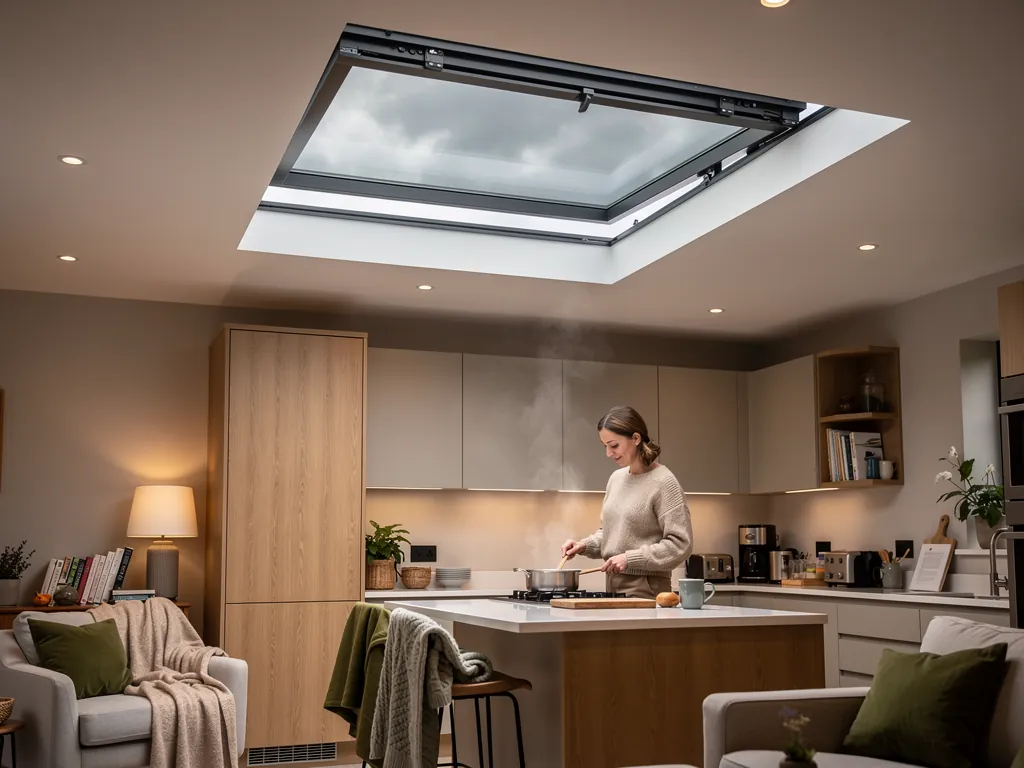
Kitchens and kitchen-diners are the busiest case. They have steam, cooking smells and often a lot of glass. An opening rooflight above or near the cooking zone works with an extractor hood, not instead of one. Open it while you cook and the extractor has less to do.
Bathrooms and en suites without a window usually have a mechanical extractor fan, and a rooflight or roof window can add a purge route for after a long shower. Humidity-sensing controls can open it for you. Loft rooms and bedrooms under a slope are often the hottest in summer, and a roof window that opens to a good angle gives a loft conversion a real chance of staying sleepable on a warm night. Our guide to roof windows for loft conversions goes further.
- 1/20of the floor area, the openable area asked for rapid ventilation when the sash opens 30° or more
- 10minutes of fully open glass, a sensible burst after cooking in winter
- 1.7metres, the height below which side-facing roof windows must be obscure glazed and fixed
Not every rooflight opens. If you already have a fixed one and want to ventilate, our short answer on whether a fixed rooflight can be made to open covers the options. Where two rooflights sit side by side, one fixed and one opening is often plenty.
07Safe and sound
Security, rain and fitting: the practical side
An open hole is only useful if you can leave it open safely. These are the checks we make before you rely on one.
A rooflight sits out of easy reach on most houses, but flat roofs on extensions can be reached from a garden wall or a shed. Look for a vent or lock position that holds the sash a few centimetres open and cannot be pushed wider from outside. Our answer on whether opening rooflights are secure sets out what to look for.
Rain is the other worry. An open rooflight in a shower is a puddle on the kitchen floor. If you ventilate while you are out, an electric rooflight with a rain sensor shuts itself, and we explain how in our guide to rain sensors and rooflight controls. For the basic mechanics of the motor and the control box, see how electric rooflights work.
When we fit or replace an opening rooflight, the work is notifiable under Part L of the Building Regulations as a controlled fitting, and we handle the Building Control notification. A free survey comes first, with a written quote that shows the openable area. One team does the work, floors and furniture are protected, and it carries a 10-year workmanship guarantee.
- We measure the room and work out the floor area you need to ventilate.
- We agree where the opening goes, and what low opening it will pair with.
- We choose a glass and a frame that suit the room's aspect, with warm-edge glazing as standard.
- We fit it, test the opening angle and the closing seal, and show you the vent position.
Will an opening rooflight clear damp and stuffy air?
Will an opening rooflight let in too much cold air in winter?
Only if you leave it open. A short burst after cooking or showering swaps damp air for dry, and the room warms up again quickly. For all-day background air, use a trickle vent in the frame. A properly closed rooflight with a good seal and warm-edge glazing keeps the heat in.
Does opening a rooflight replace an extractor fan?
No, it works alongside one. An extractor takes steam and smells at source, while the rooflight clears the rest of the room. In a bathroom without a window you will still want a fan.
Is one opening rooflight enough for a kitchen-diner?
It depends on the floor area and what else opens in the room. Rapid ventilation guidance asks for an openable area of one-twentieth of the floor area where the sash opens 30° or more, and one-tenth at 15 to 30°. We add up your rooflight, windows and doors at the survey and tell you if you need more.
Can I leave a rooflight open overnight in summer?
Only on a vent position that holds the sash a safe distance open and cannot be forced from outside. Leaving it wide open while you sleep is not something we would suggest on an accessible flat roof.
Do I need planning permission to fit an opening rooflight?
Often not, but it depends on the house and the roof. Our guide to skylight planning permission covers the conditions and when to check with the council.
Where can I find out more about electric opening rooflights?
Start with our electric opening rooflights page for the options, then book a free survey and we will look at your room.