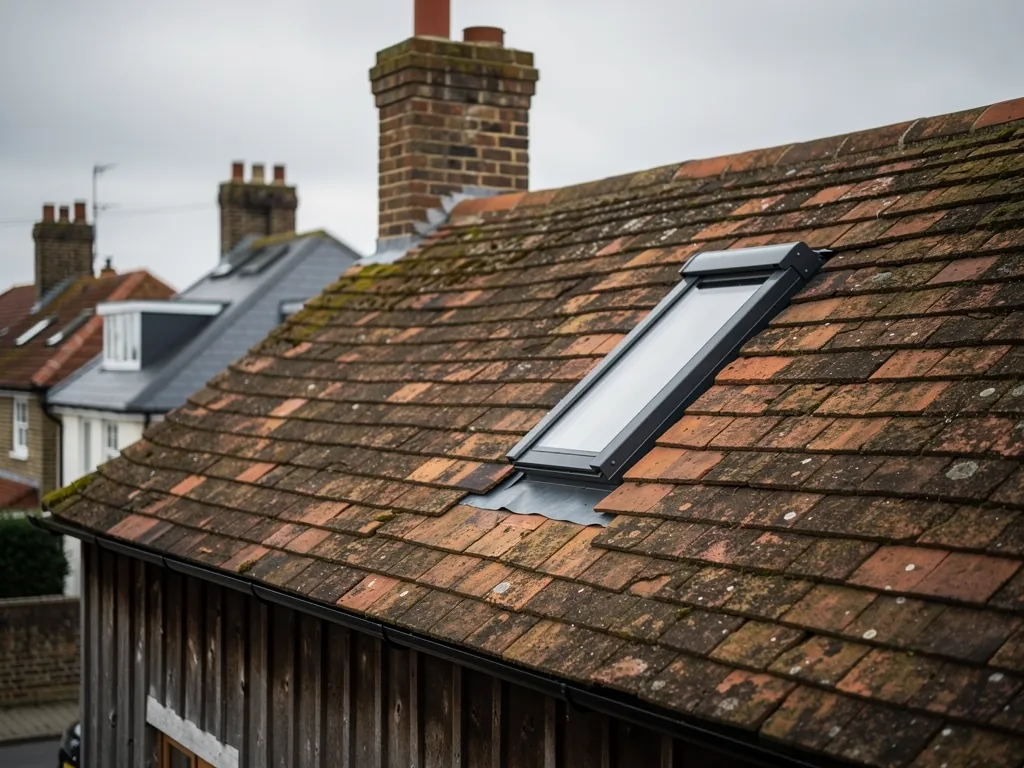
Everything that makes a rooflight warm
01The upgrade
What an energy efficient rooflight really is
It is a rooflight that lets daylight in and keeps your heating where you paid for it. Glass is only part of that. The frame, the edge of the glass and the box it sits on all count.
People often ask us for "the most efficient skylight" as if it were one product on a shelf. It is not. An energy efficient rooflight is a set of parts that work together: a sealed glass unit with a coating and a gas fill, a spacer bar round its edge, a frame that does not carry cold through itself, a kerb or collar that is insulated, and a lining on the room side that finishes the job. Weaken any one and the whole unit slips down the scale.
The reason it matters more than with a wall window is simple. Warm air climbs. In a landing, a loft room or a single-storey extension, the roof is where your heating collects, and a rooflight is a stretch of thinner material set into that roof. Glass will always lose heat faster than an insulated roof, so the question is how much faster, and what you get back for it.
What you get back is daylight on the dull days, a room that feels bigger, and less reliance on the ceiling light from morning to dusk. Our job at Radiant Skylights is to make sure you do not pay for that with a cold spot over the sofa. This page walks through the upgrade from a homeowner's side of the table: the numbers, the parts, the rules, the fitting day and the cost factors.
If you want a quick summary of how we think about it, our warm rooflight specification page sets out the build-up we work to. This page goes wider and explains why each choice exists, so you can judge a quote from us or from anyone else.
- 2.2W/m²K, the Building Regulations limit for a new or replacement rooflight in an existing home
- 5+W/m²K, roughly where an old single glazed rooflight sits
- 1.4W/m²K, a good double glazed rooflight with low-e glass and argon
- 1.0W/m²K, a good triple glazed rooflight, give or take the frame
02U-values
U-values in plain English: whole unit against centre pane
A U-value tells you how quickly heat passes through a material. Lower is warmer. The trap is that two very different numbers get quoted for the same rooflight.
Think of a U-value as a leak rate. It is measured in watts of heat escaping per square metre of the material for every degree of difference between inside and outside (the unit is written W/m²K). A thick insulated roof might sit well below 0.2. A rooflight will never get near that, so we are comparing glass with glass, and rooflight with rooflight.
Here is the trap. A glass maker can quote a figure for the middle of the sealed unit, away from the edges. The trade calls it the centre-pane value. It is a true figure, but it describes a bit of glass, not a rooflight. Nobody sits beneath a centre pane. They sit beneath a frame, a spacer bar and a glass area together, and heat takes the weakest route through any of them. The figure for the complete product is the whole-unit value, and it is always a little higher than the centre-pane one because the edges and frame leak more than the middle of the glass.
When you compare quotes, ask which number you are looking at. A brochure that proudly shows a centre-pane figure next to a rival's whole-unit figure is comparing apples with pears. The whole-unit value is the one that tells you how the finished rooflight will behave, and it is the one the Building Regulations use.
Why the tilt changes the answer
One more wrinkle: a pane of glass laid at a slope, or flat, loses heat faster than the same pane stood upright in a wall. Warm air inside the cavity circulates differently, and the surface sheds heat more freely. So the same sealed unit gets a worse number when it is tested as a rooflight than as a wall window. Do not be surprised that a rooflight figure looks higher than the one on your patio doors. Compare rooflight with rooflight only. Our guide to rooflight U-values explained goes through the maths slowly, and the short answer to what U-value a rooflight should have gives you a number to aim for.
Centre-pane value
The rate for the middle of the glass only. Flattering, useful for comparing glass makers, and no guide to how the finished rooflight performs once the frame and edge are included.
Whole-unit value
The rate for glass, spacer and frame together, tested as a complete rooflight. Higher than the centre figure, honest, and the one to ask for on every quote.
03Coatings and gas
Low-e coating and gas fill: the invisible half of the glass
Two things you cannot see do much of the work in a modern sealed unit. One bounces heat back at the room. The other slows its journey across the gap.
Low-e stands for low emissivity. A coating thinner than a hair, made from metal oxide, is applied to one face of a pane inside the sealed unit. Warm surfaces give off heat as long-wave radiation, the sort you feel when you stand near a radiator with your hand out. Ordinary glass lets a lot of that pass straight to the cold side. A low-e coating reflects most of it back into the room, while still allowing daylight through. You will never spot it with your eye, but the inner pane feels visibly less chilly to the touch on a winter morning.
The gas is the second piece. Air in the cavity between two panes carries heat across by moving about. Argon is a heavier gas, a natural part of the air we breathe, and it moves less freely, so it slows that crossing. Triple units that have narrower gaps are sometimes filled with krypton, which does the job in less space but costs more. A unit that is both low-e coated and gas filled beats a plain air-filled one by a clear margin, which is why the pair is the minimum we would put in front of you.
Gas does leak out of a sealed unit very slowly over the decades, and a good edge seal keeps that to a trickle. It is one more reason the spacer and seal deserve as much attention as the coating, a point the next chapters take up.
What sits inside a warm sealed unit
- Outer pane
- Toughened glass, built to take a knock and a hailstone
- Coating
- Low-e, on the face that looks into the cavity
- Cavity
- Argon fill, with krypton as an option in slim triples
- Edge
- Warm-edge spacer, sealed at both sides
- Inner pane
- Laminated glass on the room side where the rooflight is overhead
04Panes
Double or triple: choosing how many layers of glass
Triple glazing is warmer on paper. Whether it is better for your room depends on the size of the glass, how long you heat the space and what the roof can carry.
Double glazing with low-e glass and argon is already a long way ahead of the single glazed rooflights and the early double units that plenty of south Essex homes still have. For a small roof window on a landing or a modest flat rooflight over a utility, it is usually all the room asks for. It is lighter, which keeps the frame slim and the opening simpler, and it keeps the project cost in check.
Triple glazing adds a third pane and a second cavity. The inner pane stays much closer to the temperature of the room, which cuts the cold sensation you can feel on your face when you sit directly under a big sheet of glass. It also resists the cold downdraught that a chilly pane drives into a room. The cost is weight, a deeper frame, and a higher bill for the glass.
We do not think you should buy triple glazing because it sounds better. We do think you should look hard at it where the glass is large, the room is a sitting or dining space heated for long hours, or the glass faces north and never gets winter sun to help. Our guide to double against triple glazed rooflights goes through the trade-off, and the short answer on whether triple glazing is worth it on a rooflight is there if you want a quick steer.
| Question | Double, low-e, argon | Triple, low-e |
|---|---|---|
| Whole-unit figure, roughly | 1.4 to 1.8 W/m²K | 0.9 to 1.2 W/m²K |
| Weight on the frame | Lighter, slimmer sections | Heavier, deeper sections |
| Feel of the inner pane | Cool on a frosty night | Close to room temperature |
| Best suited to | Landings, lofts, small flat rooflights | Large panes over seating, north glass |
05Edges and frames
The edge of the glass and the frame round it
Heat takes the easiest road. On a weak rooflight, that road runs through the spacer bar and the metal of the frame, not the glass.
Every sealed unit has a bar round its perimeter that holds the panes apart. In older units this was aluminium, and aluminium carries heat very well, which is exactly what you do not want at the cold edge of a window. The tell-tale is a band of misting or damp at the bottom of the glass on a cold morning. A warm-edge spacer is made from a poor conductor, often a plastic composite or thin stainless steel, so the glass edge stays nearer room temperature. Warm-edge glazing is our standard on every rooflight we fit, and nobody has to ask for it.
Frames come next. Timber and uPVC conduct heat slowly by nature. Aluminium is strong and slim, so it suits large spans and lanterns, but metal passes heat straight through. A thermally broken frame fixes that by separating the inner and outer metal with a strip of tough insulating material, so the cold outer section never touches the warm inner one. Think of a cup with a handle that is not part of the hot metal body. You can read the full story in our guide to warm-edge spacers and thermal breaks, and the quick explainer on what a thermally broken frame is keeps it short.
Frame choice and glazing choice affect each other. A very good triple unit in a poor frame wastes most of its advantage, and a modest double unit in a well-built frame can beat it. That is why we quote the whole product, not a piece of it.
- Spacer bar made of a low-conductivity material, never plain aluminium
- Aluminium frames split into inner and outer sections by an insulating break
- Timber roof windows with the factory insulation collar fitted round the frame
- uPVC frames with several internal chambers rather than a single hollow
- Glazing bars and gaskets that hold the glass without gaps
06The kerb
The kerb or upstand: a chilly band if you ignore it
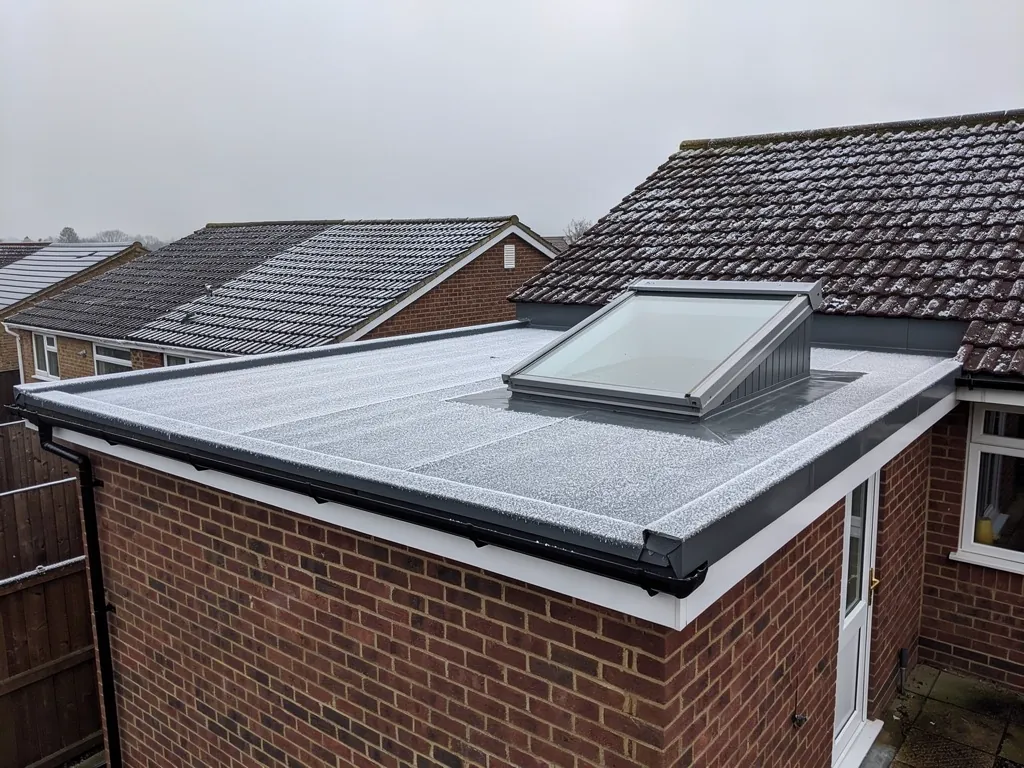
On a flat roof the rooflight sits on a raised box. If that box is bare timber, it can undo everything the glass was built to do.
The kerb (some call it an upstand) is the raised frame that lifts the rooflight clear of the roof surface. It matters thermally for a plain reason: it is a continuous ring of material going from the cold outside to the warm ceiling. If it is untreated timber or blockwork, that ring conducts heat out round the opening, no matter how fine the glass is. The spot becomes a cold bridge, which is simply a route for heat that skips round the insulation.
The remedy is to treat the kerb as part of the roof's insulation. We use either a factory-insulated upstand or a built timber kerb lined with rigid board, and then check the join with the roof build-up. The insulation in the kerb has to meet the insulation in the roof, lapping onto it, so there is no strip where the two do not touch. Our flat roof rooflights page covers the types we fit on a flat roof, and the roof lanterns page shows the same thinking on a bigger scale.
Pitched roofs deal with this differently. A roof window sits in the plane of the slope, and the maker supplies an insulation collar that goes round the frame and joins the roof layers. The fitter's task is to make sure the collar is tight to the frame and the roof insulation is brought right up to it.
07Condensation
Condensation is a symptom, so read it that way
Water on glass tells you where a surface is colder than the air next to it. That is useful information, if you know how to read it.
Condensation forms when warm, damp room air touches something cold enough to bring the water out of it. Cooking, showers, drying washing and simply breathing all put moisture into the air. A cold rooflight surface is the first place it lands. So a rooflight that streams water in winter is telling you that surface is too cold, or that the room air is too damp, or both.
Where the water appears gives you the clue. A little on the outside of the glass on a clear, frosty morning is normal and even a good sign: the outer pane is cold because the inner one is holding the heat in. Moisture on the inside face, round the edges or in the reveal corners is the warning. It points to a poor spacer, a frame that carries cold, a reveal with no insulation, or air leaking round the frame. It can also show up as grey speckles of mould, which grow where a surface stays damp and cold.
A warm upgrade deals with the cause rather than the water. A better spacer and low-e coating raise the temperature of the inner glass. An insulated kerb and reveal remove the chilly band. An airtight seal round the frame stops damp room air reaching the cold parts of the roof build-up. Ventilation still matters, and an extractor fan in a kitchen or bathroom is worth having, but it should not be asked to hide a cold bridge.
Sealed units that have failed, with a permanent haze between the panes, are a different matter, and our page on misted and failed rooflights covers replacing them.
Water on the glass is a thermometer. It shows you exactly where the cold surface is.
08The rules
What Part L says about replacement rooflights
Fit a new or replacement rooflight in an existing home and the Building Regulations set a limit on how leaky it can be. The figure is 2.2 W/m²K.
Part L of the Building Regulations covers the conservation of fuel and power. For an existing dwelling, a new or replacement rooflight has a limiting whole-unit U-value of 2.2 W/m²K, while a pitched roof window takes the window limit of 1.4 W/m²K or WER Band B. The rule sets a ceiling, not a target. Our own specification sits well inside it, because we would rather give you margin than a figure that only just scrapes through.
Replacing a whole rooflight, meaning frame and glass together, counts as a controlled fitting, so it is notifiable. Where the work has to be notified, we deal with Building Control so the paperwork is off your plate. Changing only the sealed glass unit in an existing frame is not notifiable, though the new glass should still be a sensible warm specification.
Planning is a different question from Building Regulations, and the two get muddled. Many rooflights on a house fall under permitted development, subject to conditions, and flats, maisonettes and listed buildings sit outside the simple route. The Planning Portal at planningportal.gov.uk is the place for the official rules, and the council is the final word on your own address. Listed buildings need listed building consent every time.
Two things the regulations will not do for you. They will not decide whether triple glazing is worth buying, and they will not check the join between your kerb and your roof insulation. That is where the survey comes in.
| Work | Building Regulations | Whole-unit limit |
|---|---|---|
| New rooflight in an existing roof | Notifiable | 2.2 W/m²K |
| Whole rooflight replaced, frame and glass | Notifiable, controlled fitting | 2.2 W/m²K |
| Sealed unit replaced in the same frame | Not notifiable | Good practice to match |
| Rooflight in a new extension | Covered by the extension's application | Set by the design |
09Is it worth it?
When an upgrade is worth doing, and when to leave it
Some rooflights are clearly past their best. Others are fine and need nothing. Here is how to tell which camp yours is in.
The cases where we would nudge you to upgrade are quite plain. If the rooflight is single glazed, it sits at the bottom of the scale and almost any modern replacement will feel like a different room. If you have an early double glazed unit with an aluminium spacer and no low-e coating, the edge will be cold and the centre only a little better. If the glass is hazy between the panes, the seal has gone, and there is no point holding on. If you stand under it in winter and feel the chill on your head, or see damp in the reveal, the problem is real and fixable.
There is also the case of a new use. A garage turned into a family room, a loft lined for a bedroom, or a flat-roofed extension with a new kitchen under it: all of these make you spend longer under the glass, so the comfort matters more than it did.
On the other side, a recent, well-built rooflight with a thermally broken frame, an insulated kerb and low-e glass does not need replacing for energy reasons. We would say so at the survey. You also do not need to buy the top figure. A good double unit in the right frame is the right answer for plenty of rooms.
If you are curious about how a rooflight affects a home's energy certificate, our answer on whether a new rooflight can improve an EPC rating sets out what to expect. And if you are wondering whether glass in the roof is simply a bad idea for heat, do rooflights lose more heat than windows gives a straight answer.
Signs it is time
Single glazing, a haze between the panes, an aluminium spacer with a cold edge, damp or mould in the reveal, a cold spot under the glass, or a room that now gets far more use than it did.
Signs it can wait
A modern low-e unit in a thermally broken frame, a kerb that is insulated and meets the roof build-up, a dry reveal, and no complaints from the people who sit under it.
10Fitting day
What happens on the day we fit it
One team arrives, protects the room, does the work in a sensible order and leaves the opening ready for decoration.
Ahead of the fitting day you will already hold our free survey and a written quote, which names the glazing, frame, kerb and lining. On the day, the same fitting team does the whole job from start to finish, so nothing is passed between trades and nobody has to guess what was agreed.
Floors and furniture are covered before anyone opens the ceiling. Dust sheets go down, the route in and out is protected, and the space under the opening is cleared. A rooflight job makes some dust where the ceiling is cut back and the old unit comes out, but it is contained and we clean as we go.
The old rooflight is taken out and the opening checked. If the kerb is being replaced, or a new one built, the insulation goes in before the glass does, and we check that it lines up with the roof insulation. The new rooflight is set, fixed and sealed to the maker's detail on the outside, and the airtight seal goes on the room side. Then the reveal is insulated and lined, ready for filler and paint.
A straightforward swap can finish within the day. A bigger lantern or a new opening takes longer because there is structural work. We tell you the plan on the quote, not on the morning.
- Floors, furniture and access route covered and protected.
- Old rooflight or sealed unit removed, opening and kerb checked.
- Insulated kerb or collar fitted, and its join with the roof insulation checked.
- New rooflight set, fixed and sealed on the outside to the maker's detail.
- Airtight seal made on the room side, and the reveal insulated and lined.
- Site cleared, Building Control notification handled where the work is notifiable, and the workmanship guarantee explained.
11Cost factors
What moves the price of a warm rooflight
A quote depends on a handful of choices. Understanding them lets you decide where to spend and where to hold back.
We do not publish prices here, because the true figure depends on your roof. What we can do is show you which choices push a figure up and which keep it down. The free survey and written quote then give you the real number, line by line. For general market guidance, our rooflight costs page gives broad UK ranges.
Size comes first, since glass and frame scale with the opening. After that, the frame material: thermally broken aluminium costs more than a standard uPVC finish, and a dual colour option adds more. Glazing is next: triple, solar control and self-cleaning coatings all lift the price compared with low-e double glazing. The roof itself matters, because cutting a new opening and adding new timbers is a bigger job than swapping like for like. Access matters too: scaffolding or a crane lift changes the day. Finally, extras such as opening vents, integrated blinds or built-in lighting.
The thing to watch is a quote that is cheap because it left something out. If a price says nothing about the kerb insulation or the lining, ask. Those are the parts that decide whether the room stays warm.
| Choice | Pushes the price up | Keeps it down |
|---|---|---|
| Size | Large opening, long span | Standard size, simple shape |
| Glass | Triple, solar control, self-cleaning | Low-e double, argon, warm edge |
| Frame | Thermally broken aluminium, dual colour | uPVC in a standard finish |
| Roof work | New opening, new timbers, hard access | Like-for-like swap |
12Aftercare
Looking after it once it is in
A warm rooflight needs very little from you. A few small habits keep it performing and your guarantee paperwork in good order.
Clean the glass with soft water and a squeegee or soft cloth, and avoid abrasive pads that could scratch a coating. Wipe the frame and the gasket from time to time so dirt does not build up in the drainage channels. If your rooflight opens, move the vent through its full range now and then, and check that the gasket closes evenly.
Keep the room ventilated. Use the extractor when you cook or shower, and open a window on a damp day. Even the best rooflight cannot cope with air that is constantly saturated. If you see damp returning at the edge of the glass or in the reveal, it is a useful sign, not a disaster. Tell us, and we will look at what is going on under the glass.
Your fitting comes with a 10-year workmanship guarantee. Keep the quote and the paperwork we leave you, including the Building Control confirmation where it applies, because they are the record of what was specified. If you later sell, that file is a good thing to hand to the buyer. When you are ready, our full list of services shows what else we fit.
- Soft cloth and mild soap, no abrasive pads on the glass
- Gaskets and drainage channels kept free of dirt
- Extractor fans used while cooking and showering
- Quote, specification and Building Control paperwork stored together
Which energy claims should you trust on a quote?
What U-value should an energy efficient rooflight have?
For a new or replacement rooflight in an existing home, the Building Regulations limit is 2.2 W/m²K for the whole unit. A good modern double glazed unit comfortably beats that, and a triple glazed one goes further still. Always ask for the whole-unit figure, not the centre-pane one.
Is triple glazing always better for a skylight?
It is warmer on paper, but it is also heavier and dearer. It pays off most on large panes, over rooms you sit in for long hours, and on north-facing glass. For a landing or a small flat rooflight, low-e double glazing with argon is often the sensible choice.
Will a new rooflight make my room colder?
Not if it is specified for heat. Glass always loses more than insulated roof, but low-e glass, argon, a warm-edge spacer, a thermally broken frame and an insulated kerb keep the room comfortable. A badly built one is what makes a cold spot, and that is the thing we plan against.
Do I need Building Regulations approval to replace a rooflight?
Swapping the entire rooflight, frame and glass together, is notifiable under Part L, and we send the notification to Building Control when it applies. A sealed unit changed on its own is not notifiable. Planning is a separate matter, so check with the council for your own address.
Why does my skylight have water on the inside?
Because the glass or frame is colder than the damp air in the room. It often points to an old spacer, a cold frame, an uninsulated reveal or air leaking round the opening. A warm upgrade treats the cause, and good ventilation helps too.