01Build-ups
What is actually inside a double and a triple unit
Before comparing, see the two builds layer by layer. The differences are bigger than "one more pane".
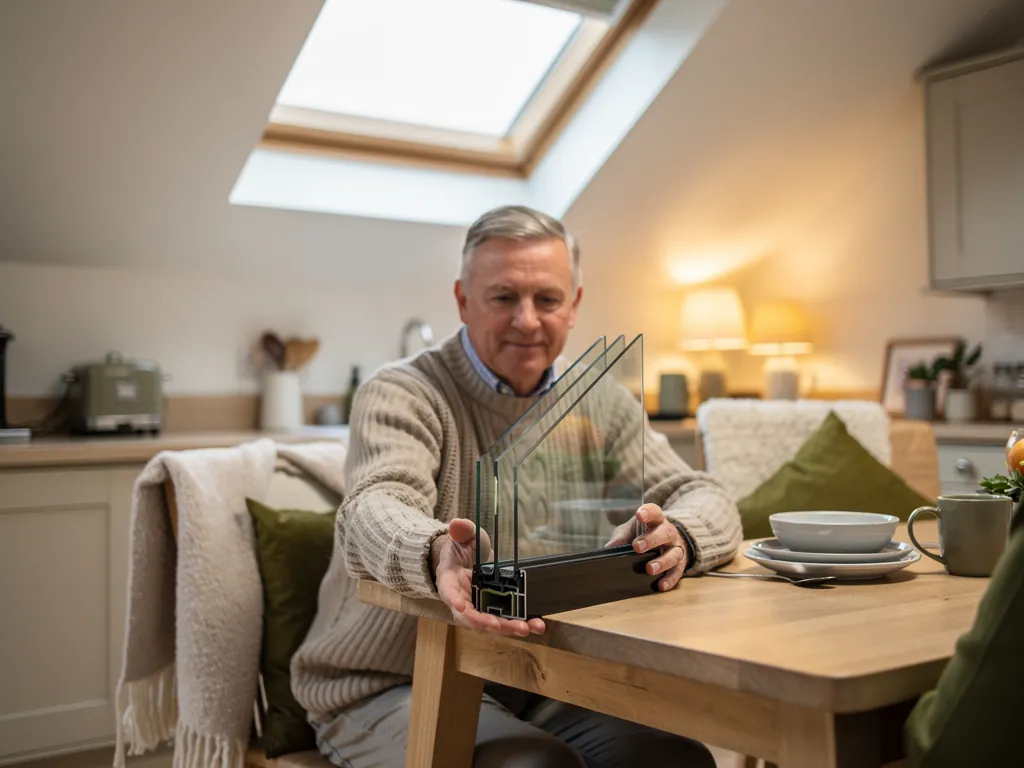
Choosing a double vs triple glazed rooflight starts with the glass itself. A sealed glazing unit is a stack of glass sheets held apart by a spacer bar round the edge, with the gaps sealed and filled with gas. A double unit has two sheets and one gap. A triple unit has three sheets and two gaps. Everything else follows from that.
In a typical rooflight the outer sheet is toughened glass, which resists knocks and hail. Where the glass is overhead, the room-side sheet is often laminated, meaning two layers bonded to a plastic interlayer so that a broken sheet stays in one piece. In a double unit those two sheets are the whole story. In a triple unit a third sheet sits in the middle, and a low-e coating can be applied on more than one surface. Low-e is short for low emissivity: a coating thinner than a hair that sends warmth back into the room and still lets the daylight pass.
Gap width matters as much as the count. A wide gap lets gas circulate and carry heat across, while a very narrow one lets heat conduct straight through. The best gap for argon gas is roughly in the middle. Triple units split the available depth into two narrower gaps, so the builder has to choose widths carefully, and some makers fill triple units with krypton, a denser gas that works well in slim gaps.
Typical sealed unit build-ups
- Double
- Two sheets, one argon gap, low-e on one face, warm-edge spacer
- Triple
- Three sheets, two gaps, low-e on two faces, warm-edge spacer
- Glass weight
- About 2.5 kg per square metre for each millimetre of glass thickness
- Overhead glass
- Laminated room-side sheet is good practice
- Edge
- Warm-edge spacer is our standard on both builds
02Heat
How much warmer the third pane really is
Triple glazing is warmer on paper. The useful question is by how much, and whether the extra warmth lands where you sit.
For the glass alone, a good double unit with low-e coating and argon sits around 1.0 to 1.1 W/m²K, and a good triple unit sits around 0.5 to 0.7. Those are glass-only figures, and the frame and edge pull both up. As finished rooflights the typical figures are closer together, around 1.4 for a good double and around 1.0 for a good triple. Our guide to rooflight U-values explained shows why glass-only and whole-unit figures differ and how to turn either into watts.
Take a rooflight of 1 square metre in a winter that holds a 20 degree gap between inside and outside. At 1.4 W/m²K it loses 28 watts. At 1.0 it loses 20. The difference is 8 watts for every square metre of glass, roughly the output of a night light bulb. On a landing skylight of half a square metre that saving is too small to notice. On a 4 square metre lantern over a dining table it adds up to 32 watts, which begins to be a figure worth thinking about, particularly for a room heated for long hours.
| Roof opening | Extra heat kept by triple | Worth weighing? |
|---|---|---|
| 0.5 square metres | About 4 watts | Rarely |
| 1 square metre | About 8 watts | Sometimes |
| 2 square metres | About 16 watts | Yes, if the room is a heated living space |
| 4 square metres | About 32 watts | Yes, strongly |
Those sums use the whole-unit figures of 1.4 and 1.0 W/m²K at a 20 degree gap. They compare the two builds and are not a prediction of what you will pay.

03Comfort
The feel of the inner pane, which a U-value hides
Energy figures count heat lost. Your skin counts something else: how cold the glass is and how much cold air it drops on you.
The inner surface of a rooflight is colder than the room air in winter, and the colder it is, the more you feel it. A body near a cold surface loses heat by radiation toward it, which feels like a chill on your face and shoulders even when the thermostat reads 21. Cold glass also cools the air touching it. That air gets denser and sinks, which you feel as a slow draught called downdraught, though the rooflight has no leak at all.
A third pane pushes the inner surface temperature closer to the room air. In practice that means the chill under a big stretch of glass drops away on frosty mornings, and the surface is less likely to mist when you cook, shower or dry washing in the room. A double unit with a good coating and warm-edge spacer is comfortable for most rooms, but it will feel cooler than a triple of the same size when you sit directly beneath it.
Double, low-e, argon
Inner pane noticeably cooler than the room on the coldest nights. Fine over a landing, bathroom, utility or a loft room you pass through. A sensible default for smaller openings.
Triple, low-e
Inner pane stays nearer room temperature, so less radiant chill and weaker downdraught. Earns its keep over a sofa, a desk or a dining table in a room you heat for long hours.
04Daylight
What the extra glass takes from the light
Every sheet of glass and every coating absorbs and reflects a little daylight. Triple glazing is a trade, and the cost shows up in two places.
Two measures matter. Light transmittance is the share of visible daylight passing through the unit. The g-value, a number between 0 and 1, is the share of the sun's energy that gets through as heat. Adding a third pane and a second coating lowers both slightly. The room is a touch dimmer, and the sun warms it a touch less.
On a grey Essex January afternoon, the light difference is small enough that most people cannot tell two rooflights apart by eye. The solar gain difference is the more interesting one. A south-facing or west-facing double unit can collect winter sun that helps heat the room, while a triple blocks a little more of it. On a north-facing roof, where that sun never arrives, the lower heat loss of triple is all gain. On a west-facing extension that overheats in July, the lower g-value of triple is a small help in the opposite direction, though it is no substitute for proper shading and ventilation.
05Weight
Weight, frames and what your roof can carry
A third sheet adds load. That reaches the frame, the kerb and the structure beneath, so it needs checking before it is ordered.
Glass weighs about 2.5 kilograms per square metre for every millimetre of thickness. A double unit made of two 4 millimetre sheets weighs about 20 kilograms per square metre. A triple of three 4 millimetre sheets weighs about 30. Laminated glass, thicker panes for a larger span or a deeper unit all add more. Over a 4 square metre lantern, the difference between a double and a triple is more than 40 kilograms before you count the frame.
That weight rides on the kerb or upstand, which sits on the roof structure. A flat roof extension built for a slim glazed unit may need the opening checked before it takes a heavier one. The frame also deepens to hold a thicker unit, and deeper sections can mean thicker bars and a slightly chunkier look. Our guide to aluminium vs uPVC roof lanterns explains how frame material sets how slim the bars can stay, and for flat roofs the page on rooflight kerbs and upstands covers what the base has to carry.
- Ask for the sealed unit weight per square metre, not just the pane count.
- Check the kerb and roof structure can carry the heavier unit across the full opening.
- Confirm the frame depth fits the glass build and the thermal break stays continuous.
- Ask how the bars look in the deeper section if slim bars matter to you.
- For opening units, check the opener and hinges are rated for the weight.
06Room by room
Choosing for the room you actually have
The right build comes from the room, not from the brochure. Here is how the choice tends to fall across the homes we meet in Basildon and its surrounds.
A dark landing or hallway in a post-war new-town house has a small opening and little time spent under it. A double unit does the job, and money is better spent on a good kerb and a lined shaft. A loft room in a chalet bungalow in Laindon or Rayleigh has more glazing and people who sit or sleep beneath it, so the comfort of the inner pane counts for more. A kitchen-diner lantern on a 1960s or 1980s flat roof extension may be the largest piece of glass the house has ever had.
The simple rule is that triple earns its extra cost as area, hours of use and cold exposure go up. Small, brief, sunlit openings favour double. Large, long-heated, north-facing ones favour triple. Between those ends, the choice is real and depends on how you feel about cost against comfort.
| Room | Leans toward | Why |
|---|---|---|
| Landing or hall | Double | Small glass, passing use |
| Bathroom | Double or triple | Triple resists misting on the inner pane |
| Loft bedroom | Either | Depends on size and where the bed sits |
| Kitchen-diner lantern | Triple | Large area, long hours, people beneath |
| North-facing extension | Triple | No winter sun to offset the loss |
If you want a quick steer, our short answer on whether triple glazing is worth it on a rooflight gives a rule of thumb, and our note on whether VELUX windows are triple glazed covers that range.
07Deciding
Settling it at the survey and on the quote
A good decision has a method. These steps take you from the room to a written spec you can hold us to.
Glass is one of several things that decide how warm a rooflight room is. The kerb, seals and lining carry just as much weight, and a triple unit on a poor upstand will be beaten by a good double on a well-built one. That is why we look at the whole warm specification before recommending either build, and why the guidance on the parent page, energy efficient rooflights, treats glass as one part of a set.
- Measure the opening and note which way it faces and how the room is used.
- List where people sit or stand beneath the glass, and for how many hours a day.
- Ask for both builds priced side by side, with whole-unit U-values for each.
- Check the structure and kerb can carry the heavier unit, if triple is on the table.
- Choose on comfort under the glass first, then on the running saving, then on cost.
- Get the chosen spec, spacer and kerb insulation written on the quote.
Our free survey and written quote put both builds in front of you in plain words, with warm-edge glazing as standard, the Building Control notification handled where the work is notifiable, one team from start to finish and a 10-year workmanship guarantee. Book your free survey and we will measure the room before we suggest a thing.
Is triple glazing worth the extra for my rooflight?
Is triple glazing always better for a rooflight?
It is warmer, but not always better for the room. A third pane adds weight, a deeper frame and slightly less daylight and solar gain. It pays off most over large, long-heated or north-facing glass.
Will triple glazing stop condensation on the inner pane?
It makes it less likely, because the inner surface stays warmer. Condensation also depends on how much moisture the room makes and how well it is ventilated, so glazing alone is not the whole answer.
Does a triple glazed rooflight let in less light?
Slightly. Each extra sheet and coating absorbs a little daylight. The difference is small enough that most people cannot see it, but it is there on paper.
Can any roof take a triple glazed rooflight?
Not automatically. Triple units are heavier and need a deeper frame, so the kerb and structure should be checked at survey before one is ordered.
Is a good double better than a poor triple?
Often, yes. The spacer, frame, kerb insulation and seals decide a lot. A well-built double can feel warmer than a triple on a cold-bridged upstand.