01The answer
Yes, winter fitting works, with a plan
The cold itself is rarely the issue. Rain, wind and short days are what we plan around.
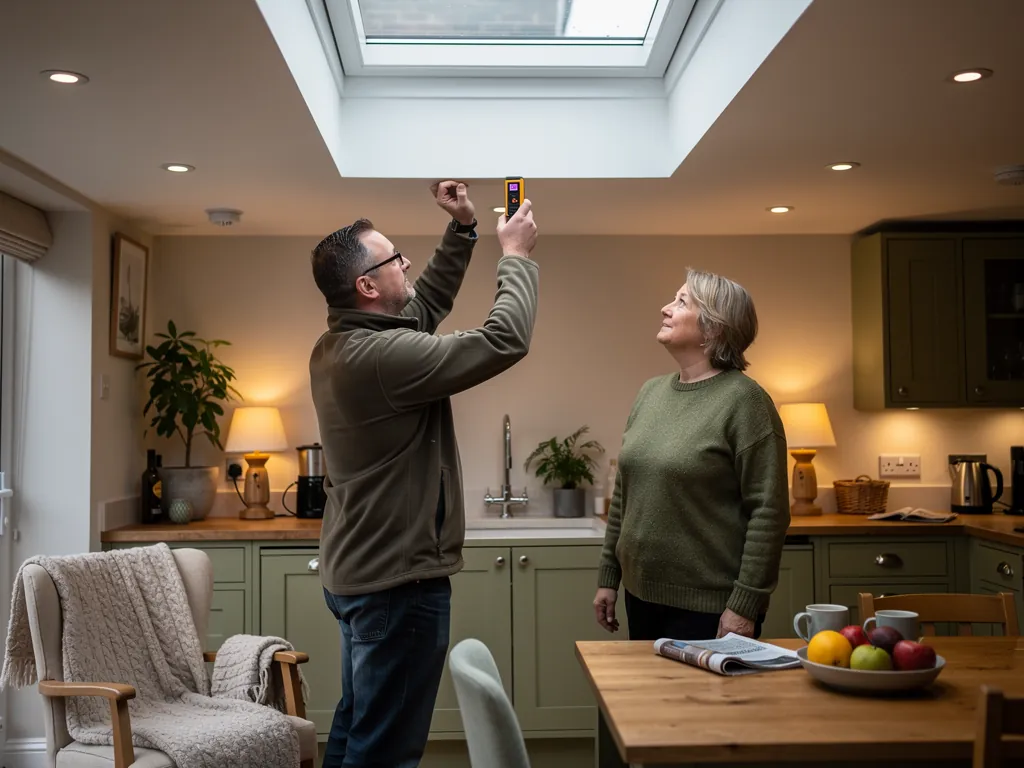
Can skylights be fitted in winter? Yes, and rooflights too, and plenty of people choose to, especially when the old one is dripping or draughty and they would rather not wait for spring. What changes is the order of work and the choice of day. A roof opening needs a dry spell, so the job is booked against the forecast instead of fixed months ahead.
The sensible approach is to watch the forecast for a few days, pick a window when rain is not expected, and have the unit on site and ready before anyone lifts a tile or cuts into a membrane. Shorter days also matter. In midwinter there is less light to work in, so a job that fits one summer day may be planned over a little longer.
We tell you plainly when a day is not right, and the whole Radiant Skylights team works to the same rule: no opening without cover ready. A short wait for a better day costs far less than a wet ceiling, and it keeps the finished rooflight or skylight in good order from day one. If rain turns up or gusts rise, the roof stays covered and we move the job. That is better than rushing it.
Winter does not stop a fitting. It just means the roof is only opened when the day is dry enough to close it again.
02Cover
How the roof is kept protected while it is open
An opening is never left to chance: it is covered, and a long job is staged so it is closed up each time we stop.
On a like-for-like swap, the old unit comes out and the new one goes in within the same visit, so the roof is open only briefly. On bigger jobs, such as a new opening or a lantern, the work is split into stages. Each stage ends with the roof covered over with temporary protection, such as heavy-duty sheeting fixed down against wind, so that overnight rain does not get in.
Inside, floors and furniture are protected before work starts, with sheeting along the route to the room and over what cannot be moved. That matters more in winter, when mud, wet boots and damp tools are coming in and out.
- Check the forecast for the day and the one after
- Have the unit, flashings and materials on site before opening the roof
- Open only the area that can be closed again the same day
- Fit, then cover any unfinished area with temporary sheeting
- Return when the next dry spell arrives and complete
03Materials
Temperature limits on products
Some of the materials on a roof need a minimum temperature to cure or stick, and cold spells can stop certain steps.
Adhesives, sealants, some flat roof membranes and liquid coatings have manufacturer limits, often with a minimum temperature for application and a note about frost or damp surfaces. On a very cold, damp or frosty morning, those steps can be postponed until the surface is dry and the temperature has risen. Mechanical parts, such as a roof window frame and its flashing kit, are less affected.
Plaster is the other one. Wet plaster dries slowly in a cold, damp room, so the lining takes longer to finish in January than in June. If the heating is on and the room is ventilated, it dries faster. We follow the maker's instructions for each product and plan the order accordingly.
What winter changes
- Choice of day
- Dry, not windy; booked against the forecast
- Roof opening
- Kept small, covered at the end of each stage
- Adhesives and membranes
- Applied only inside the maker's temperature range
- Plaster and paint
- Slower to dry, so allow longer
- Working light
- Shorter days, so fewer hours on the roof
04Timing
Is winter a good time to book?
There are good reasons to go ahead in the cold months, and a few to wait.
Reasons to go ahead: an old unit is already costing you warmth, you can see a dripping or misted pane, and a new one with a warm-edge sealed unit and an insulated kerb starts helping the room on its first cold night. Winter is also when you notice cold spots most, so it is when you know where a rooflight is most needed. Lead times for made-to-measure units can also run for weeks, so ordering in autumn means fitting in a winter window instead of waiting.
Reasons to wait: a large lantern, or a job with a lot of plastering or decorating, is calmer in drier, warmer months. If the date is flexible and the roof is sound, there may be no harm in waiting. We tell you straight which camp you are in after the survey. See how long fitting takes for what drives the timing, and do skylights make a room cold if warmth is your main worry.
Go ahead now
The old unit is draughty, misted or dripping, the job is a straight swap and you want the room warmer before the coldest weeks.
Consider waiting
It is a large lantern or a new opening with heavy finishing, and the roof is sound enough to wait for steadier conditions.
Cold weather, open roofs and other January worries
Will my house be cold with a hole in the roof?
Not for long. On a swap the opening is closed again within the visit, and on staged jobs it is covered until the next stage. Rooms below are protected and the heating can stay on.
What if it rains on the day?
We do not open a roof into rain. If the forecast turns, the job moves, and any area already open is covered. Our roof windows page shows what a typical fitting involves.
Does frost stop the work?
It can pause steps that need a minimum temperature or a dry surface. Other parts of the job carry on, and we reschedule the rest.
Does a winter fitting need a different Building Control process?
No. The same rules apply in every season, and we handle the notification where the work is notifiable. Our page on Building Regulations for rooflights explains.