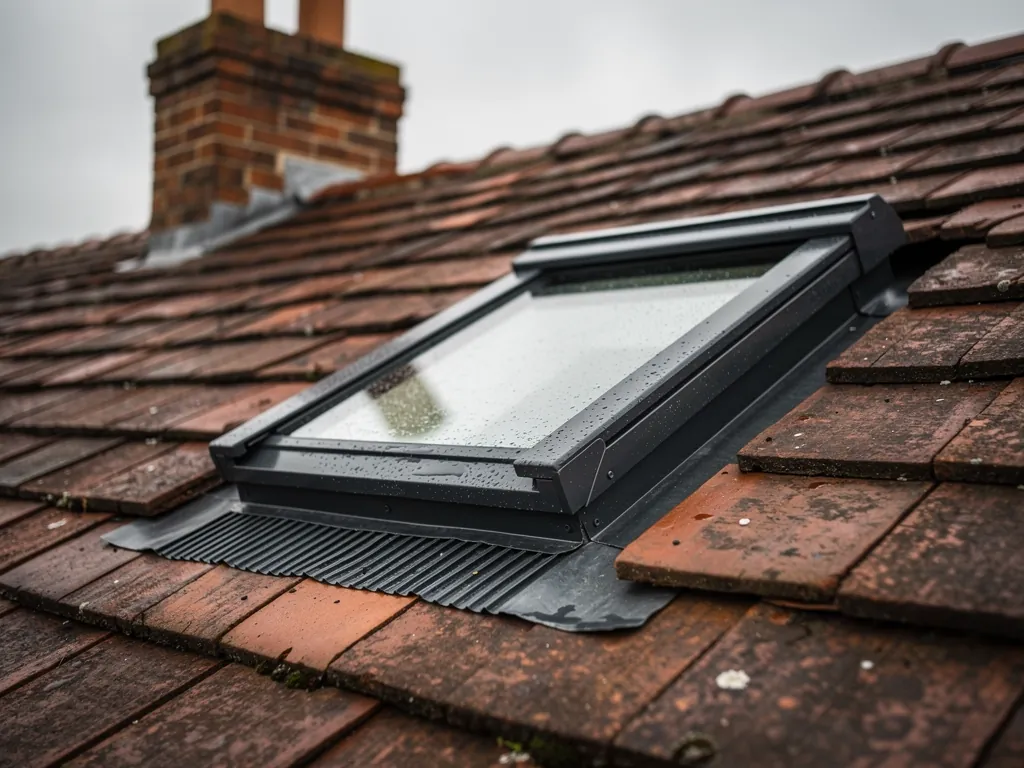
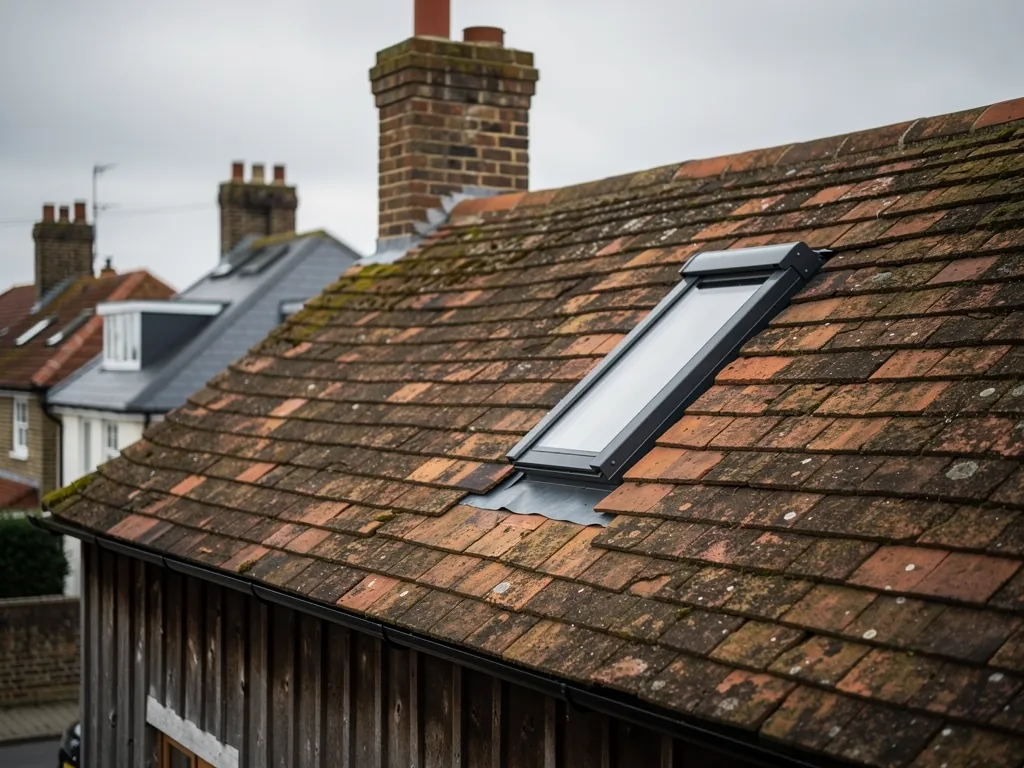
01Two pitches
The roof's fall and the glass's slope are not the same thing
When people ask about flat rooflight pitch they usually mean one of two angles, and each has its own answer.
A flat roof is not truly flat. It is built with a gentle slope, called a fall, so rain runs towards the gutter or outlet instead of pooling. That fall is tiny, often just a degree or so, and you cannot see it from the garden. This is the roof's pitch.
A flat rooflight is a different thing. It is a sealed glass unit or a low glazed dome that sits over an opening in that roof, usually on a raised kerb. The glass is fitted close to level, but not dead level. Manufacturers build a small slope into the kerb or the unit itself, so rain and melted frost slide off the glass and do not sit in puddles that leave rings and a green film. That slope is the pitch of the rooflight, and it is what the question is really about.
So there are two numbers to keep apart. The roof needs a fall to drain. The rooflight needs a slope on the glass to shed water. A good fit gets both right at once. Our page on the main flat roof rooflights range shows how they sit together.
- The roof deck has a fall towards a gutter or outlet
- The kerb is level, so the unit sits square and does not twist
- The glass has a built-in slope, either in the unit or the kerb top
- Nothing creates a dip where water can collect against the frame
02The figure
How much slope does the glass need?
There is no one national number. The maker states it, and it is usually a few degrees.
Manufacturers of flat rooflights commonly specify a minimum slope of around 3 to 5 degrees on the glass, though some products suit shallower angles and others ask for more. A few degrees is enough for water to run off rather than sit still. Below that, dirt and water collect on the surface and stain it.
That is a typical range, not a rule for your roof. Always follow the maker's figure for the exact unit you are fitting, because the sealed unit, the seals and the guarantee are all designed around it. If a fitter tells you "it will be fine at nearly flat", ask which instructions they are following. A flat rooflight fitted outside its stated range can leave you with ponding on the glass and a cold, damp joint at the frame.
Some rooflights get their slope by design. A flat glass unit may have a kerb with a built-in rake on the top face, so the unit sits at an angle on a level roof. Others are low pyramid or domed shapes, whose surface slopes away from the centre so there is no flat spot at all. The options are set out in our guide to the types of flat roof rooflight.
| Shape | How it sheds water |
|---|---|
| Flat glass on a raked kerb | The kerb top is cut at a slope, so the pane tilts |
| Flat glass on a level kerb | Needs the maker's approval and a self-cleaning or low-friction coating |
| Pyramid or low dome | Each face slopes away from the centre |
| Roof lantern | Steeply pitched glass on every side |
03Water
What happens when the pitch is too shallow
A rooflight with no fall collects dirt, grows algae and is harder on the seals than one that drains.
Water that sits on a pane carries dirt with it. When the water dries, the dirt stays behind as a ring. Over a season those rings build into a stain you can see from inside, and it cuts the daylight. On a pane that never drains, algae also gets a footing in the damp corners, especially on shady sides.
Standing water is hard on the edges too. It sits against the seals and the frame for longer, and in a hard frost it can freeze there. A good slope and a sound fit keep the glass edge clear. It also helps the glass edge stay warm, because a wet, cold joint loses heat faster than a dry one. That is part of why we build the kerb, the seal and the fall as one warm, drained assembly rather than as separate trades.
A skylight that drains is a skylight that stays clear, and one that stays clear lets in more of the light you paid for.
Condensation is a separate matter, but the two tie in. Cold, damp glass edges are where moisture shows first, which is why our answer on whether flat rooflights get condensation looks at the edge detail too.
04On your roof
Getting it right on a south Essex flat roof
The roof covering, the kerb and the glass all have to agree, and the survey is where that gets checked.
Across Basildon, Wickford and Laindon you find single-storey flat-roof extensions built from the 1960s onwards. The fall on those older roofs can be uneven. Years of sag, a lumpy covering or a blocked outlet can leave a dip right where you want the opening. A good fitter checks the actual fall at the survey, not the one on a drawing, and builds the kerb so the unit sits level and square.
The kerb is where most of the answer is found. Its top edge sets the slope of the glass, and its height keeps water away from the joint. We cover how it is built on our page on rooflight kerbs and upstands. The covering matters too. EPDM and GRP are both common on flat roofs and both suit rooflights, with different details at the edge, as set out in can a rooflight go on an EPDM roof and its GRP sister page.
- Check the actual fall of the existing roof around the opening.
- Choose a unit whose stated minimum slope suits the build.
- Build the kerb level, with a raked top or the maker's rake where needed.
- Insulate it and tie it into the roof insulation, as set out in our warm specification.
- Run the membrane up and over, so water leaves the kerb as well as the glass.
Under Part L of the Building Regulations, a complete rooflight with its frame and glazing is a controlled fitting. All our work meets current Building Regulations, and where notification is needed we send it to Building Control ourselves. A free survey and written quote will tell you what your own roof needs.
How flat is too flat?
Can a rooflight be fitted dead flat?
Only if the maker says that product can be. Most flat rooflights need a small slope on the glass to shed water. Check the instructions for the exact unit and follow the figure they give.
What is the minimum fall on a flat roof itself?
Flat roofs are built with a gentle fall so water drains. The figure depends on the covering and the design, and the roofer or the covering maker will specify it. It is a different measurement from the slope of the rooflight glass.
Does a steeper rooflight stay cleaner?
Yes, within reason. The steeper the glass, the quicker water runs off and the less dirt settles. That is why roof lanterns and pyramid shapes tend to stay clearer than flat glass. Our guide to cleaning a roof lantern has more on upkeep.
Will the pitch change how the rooflight looks from the garden?
Slightly. A raked kerb gives a low, tilted look that is hard to spot from the ground. A pyramid or lantern shape stands up more. Your survey is the time to look at the options for your own roofline.