01The families
Six kinds of rooflight that sit on a flat roof
Before you compare prices or brands, it helps to know which family of rooflight you are actually looking at. Each one solves a different problem.
People say "skylight" for anything glazed that sits in a roof. On a flat roof, the trade splits the choice into a handful of families, and the names on a quote only make sense once you know them. This guide sits under our flat roof rooflights page and goes into the detail that page only sketches.
The six families are the flat glass rooflight, the pyramid, the polycarbonate dome, the ridgelight (a long, low run of pitched glass), the walk-on panel and the roof lantern. Some are made for a kitchen extension in Laindon. Some belong on a garage conversion in Wickford. A few suit nothing in a lived-in room at all.
Notice what they share. Every one is a piece of glazing set on a raised frame, called a kerb or upstand, that lifts it clear of standing water. If you want that part explained properly, read our guide to rooflight kerbs and upstands alongside this one.
| Type | Shape | Best for |
|---|---|---|
| Flat glass | Single flat pane, almost level | Slim, modern ceilings |
| Pyramid | Four sloping faces to a point | Square rooms, hallways |
| Dome | Moulded plastic bubble | Sheds, garages, utility rooms |
| Ridgelight | Long, low pitched glass | Narrow extensions, side returns |
| Walk-on | Thick flat glass, load rated | Terraces, floors above rooms |
| Roof lantern | Tall pitched glass roof | Kitchen-diners, garden rooms |
02Flat glass
The flat glass rooflight: slim, plain and very bright
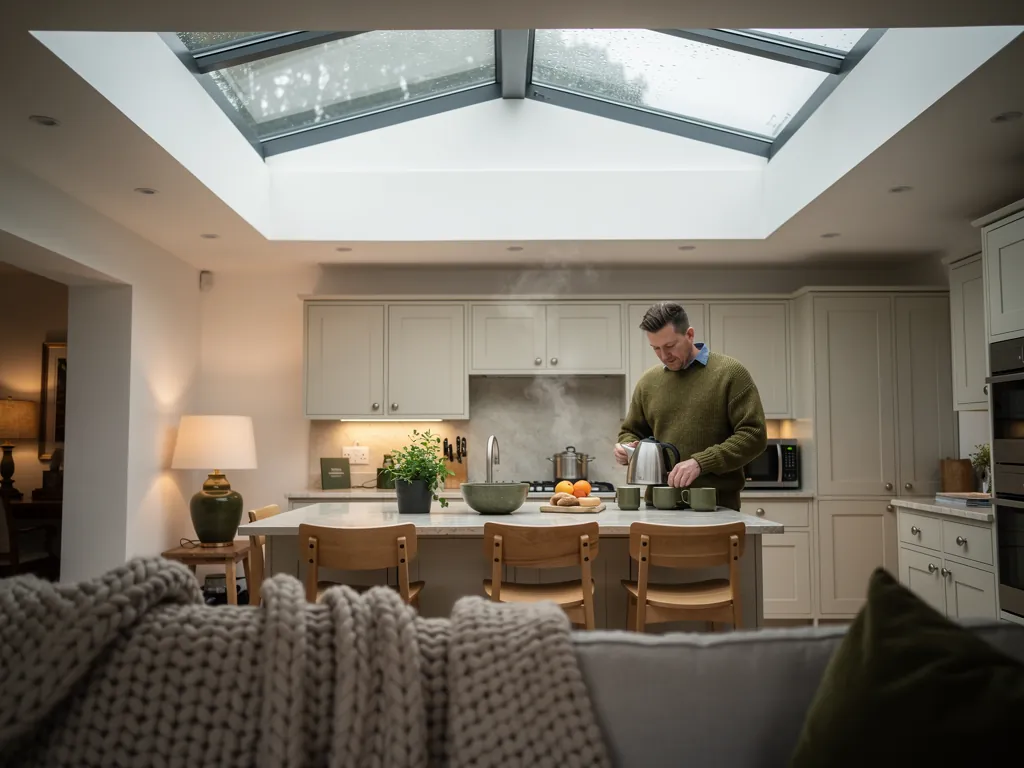
This is the neat, almost level rooflight you see in newer extensions. It gives a lot of daylight for very little visible frame.
A flat glass rooflight is a single sealed double glazed unit, or sometimes triple, bedded into a shallow frame on the kerb. From inside it reads as a clean pane in the ceiling. From outside it sits only a few centimetres proud of the roof.
The glass is not truly flat. It has a slight fall, often only a degree or two, so rain can run off. Some versions are fitted flush with the roof covering, which looks smart, though the join to the roof membrane then needs careful detailing. On a roof with a small fall already, a flat pane copes well. On a roof with almost none, standing water can leave a ring of dirt on the glass, which is why the roof's own fall matters more than the rooflight you pick.
Glass this flat is the brightest of the six for its size, because there is no ridge or bar to cut light. It also gathers the most summer sun straight overhead. We talk to you about tinted or solar control glass where a room faces south or west, so the extra light does not turn into extra heat in July.
- Ask whether the glass is toughened outside and laminated inside, so a broken pane holds together.
- Check the quoted size is the clear glass, not the outer frame.
- Look for a self-cleaning coating if the pane will be out of reach of a ladder.
- Confirm the roof beneath has a fall of at least a degree or two, or that one will be built in.
- Ask for the U-value of the whole unit, frame included, in W/m²K.
03Pyramids
Pyramids, domes and why they are not the same thing
Both are old favourites on flat roofs, and both get called "a skylight" in the same breath. They differ in glass, heat loss and looks.
A glass pyramid has four triangular faces rising to a point, glazed with double glazed units. It suits a square space, like a stairwell, a landing or a small garden room. Because the glass is angled, it throws light across the whole room rather than straight down in one pool.
A dome is a moulded bubble, almost always polycarbonate or acrylic, set on a kerb. It costs less to make and weighs little, which is why you see it on garages, workshops and outbuildings across Basildon and Pitsea. Plastic domes, even twin or triple walled, lose more heat than a good glass unit and can look dated against a modern roof. They also scratch and yellow over time.
For a room you live in, we steer you to glass. For a store, a shed or a cold porch, a dome is a sensible, honest choice.
Glass pyramid
Better heat performance, a crisper look and the option of toughened, laminated and solar control glass. Suits living spaces. Needs a square or near square opening to look right.
Polycarbonate dome
Light, simple and cheaper to buy. Fine for utility rooms and outbuildings. Weaker on insulation, and the plastic ages in sunshine, so expect to replace it sooner.
04Long runs
Ridgelights, lanterns and walk-on panels
These three take the idea further: more glass, more height, or glass you can stand on.
A ridgelight is a long, shallow pitched glazed unit, like a lantern that has been stretched and lowered. It fits where a lantern would be too tall or too wide, such as a narrow side return extension of the kind common on Victorian and 1930s terraces. You get a line of daylight along the length of the room.
A roof lantern is the taller, grander option. It has glass on all four sloping sides and a ridge along the top, so it adds height and gives the room a centrepiece. We cover them in full on our roof lanterns page. A lantern needs a deeper kerb and a bigger opening, and the structure under it must be sized to carry the weight.
A walk-on rooflight is thick, flat, laminated glass made to take a person's weight, set into a terrace or a garden path so light passes down into the room below. The glass is far thicker than a normal pane, made of several layers, and the surface is treated so it is not slippery when wet. Our walk-on rooflights page explains the loads and finishes.
05Opening
Fixed, opening and vented: the other choice inside each type
Whichever family you pick, you also decide whether the rooflight stays shut or opens, and how it opens.
A fixed rooflight does not move. It has the fewest parts, the slimmest frame and the best chance of staying airtight. It is the right choice over a staircase, a hall or any room with other windows for fresh air.
An opening rooflight lifts on hinges or a motor so you can let hot air escape. Warm air rises, so a rooflight at the highest point of a room is a very effective vent. In an extension that gets stuffy in summer, an opening panel can cool the space far better than a side window can. We explain the trade-offs in fixed vs opening flat rooflights, and the motorised versions with rain sensors on our electric opening rooflights page.
Pyramids, domes and flat glass panels all come in opening versions. Lanterns open through a vent in one or more sides. Walk-on glass almost never opens, because the load rating depends on the glass being fully supported.
| Type | Fixed | Opening |
|---|---|---|
| Flat glass | Yes | Yes, hinged or motorised |
| Pyramid | Yes | Yes, with a vent |
| Dome | Yes | Yes, hinged |
| Ridgelight | Yes | Yes, vented sections |
| Walk-on | Yes | Rarely |
| Roof lantern | Yes | Yes, vented sides |
06Heat
How each type behaves on a cold February morning
Rooflights lose heat faster than the insulated roof around them. How much depends on the glass, the frame, the spacer and the kerb.
Heat escapes in three places: through the glass, through the frame and through the join between the frame and the roof. A better rooflight tackles all three.
Glass is rated by its U-value, a figure for how fast heat escapes through it, expressed as W/m²K (watts for every square metre, per degree of temperature gap). The lower, the better. The edges matter too. A warm-edge spacer is the strip between the panes that holds them apart, and our standard glazing uses warm-edge spacers because the older metal type chills the rim of the glass and is where condensation starts. Read more in warm-edge spacers and thermal breaks.
Then there is the kerb. A bare, uninsulated upstand is a cold bridge straight through the roof, which is why people spot damp patches around the edge of a ceiling opening. An insulated kerb closes that gap and keeps the room's heat where you paid for it.
- 1.4W/m²K, a sound double glazed rooflight, measured as a complete unit
- 1.0W/m²K or lower, a good triple glazed unit with a thermally broken frame
- 150mm, the furthest a house rooflight may stand proud of the roof slope under Class C permitted development
Where the figures are tight, you can compare options in rooflight U-values explained.
07Choosing
A short way to pick the right type for your roof
Five questions will narrow six types to one or two before anyone visits.
- What is under the opening: a lived-in room, a stairwell, a utility room or a shed? Living spaces point to glass.
- How tall can the finished roof be? A planning limit or a neighbour's window can rule out a lantern.
- How much fall does the roof have? A near level roof suits flat glass less well than a pitched ridgelight or pyramid.
- Do you want to open it? If yes, choose the type that gives you a vent where hot air collects.
- Will anyone ever stand on it, or might a ladder lean on it? That decides whether you need walk-on glass.
Once you have a shortlist, think about what is already on the roof. Our guide on fitting a roof lantern on an existing flat roof covers how the build-up beneath affects any type, not only lanterns.
08Next steps
What happens when we survey your flat roof
A free survey turns a shortlist into a firm recommendation, with a written quote you can compare.
We come to your home, measure the opening and the roof around it, and check what lies beneath: the joists, the insulation and the roof covering. We look at which way the room faces and what the sun does to it. Then we talk through the types that fit and the ones that do not.
Fitting or replacing a whole rooflight is covered by Building Regulations, and where the work is notifiable we make the Building Control submission on your behalf. The same team that surveys also fits, protects your floors and furniture, and stands behind the work with a 10-year workmanship guarantee. If you are replacing an old unit, our page on replacing an old rooflight explains what comes out and what goes in.
Picking between lanterns, domes and flat glass
Which type of flat roof rooflight lets in the most light?
A flat glass rooflight, because it has the least frame and no bars across the glass. A large pane over a kitchen can brighten a whole room. Glass and size matter more than the type name alone.
Is a roof lantern the same as a skylight?
A roof lantern is one kind of skylight, or rooflight. It has sloping glass on every side and a ridge, so it stands taller than a flat pane. Both words describe glazing set into a roof.
Are plastic domes any good?
They are fine for garages, sheds and utility rooms where cost and light matter more than warmth. For a room you sit in, a glass rooflight insulates better and looks sharper.
Can I fit a rooflight on a roof with almost no slope?
Yes, once the roof has a small fall so water runs away. Flat glass, pyramids and lanterns all work with the right fall. We check it at the survey and can build in extra fall where needed.
Do I need permission for a flat roof rooflight?
That depends on the building. A house rooflight can fall under permitted development, but flats, listed homes and some conservation areas differ. Our skylight planning permission page sets out the rules, and you can check with the council. Building Regulations apply to the glazing itself.
Can the rooflight open for ventilation?
Yes, each type comes in an opening version except walk-on glass, by hand or by motor. Hot air collects at the highest point, so an opening rooflight is a very effective way to cool a room.