01The limit
The size is set by the roof, not by the glass
There is no single biggest flat rooflight. The practical limit comes from four things, and the weakest of them sets the ceiling for your roof.
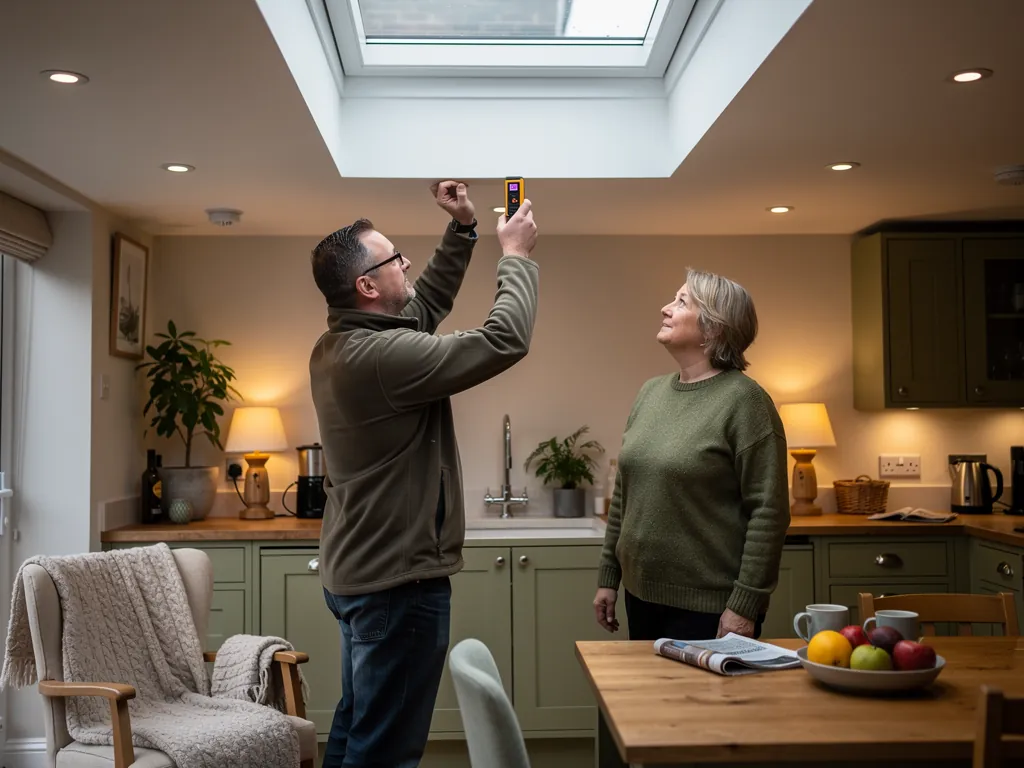
People often ask for a number, and a number would mislead you. Glass makers offer wide ranges of sizes, but what you can fit in your roof depends on what is holding the roof up. A big skylight means a big hole in the roof structure, and the timbers that were cut or moved to make it have to be carried by something else.
So the question to ask is not how big the rooflight can be. It is how big the opening can be in your particular roof, and whether the rooflight you want is made to fit it. The four limits below decide that, and we go through them on the free survey before anything is priced.
What sets the size
- Joists
- Their direction, depth and spacing, and what lies beyond the opening
- Structural opening
- The trimmed hole, with beams or doubled timbers around it
- Glass weight
- Thickness, build-up and number of panes
- Maker's range
- The sizes the manufacturer actually produces and tests
02Structure
Joists and the opening around the glass
The roof is a set of parallel timbers carrying the deck, and every one you interrupt needs a replacement load path.
On a typical flat roof, the joists run in one direction and sit at regular spacings, commonly 400 or 600mm apart. A small rooflight can often fit between two of them. A wider opening means cutting one or more joists, and the cut ends must be carried on a doubled joist or beam each side, called a trimmer (a timber that frames the edge of the opening and takes the load from the cut ones). Wider openings need heavier trimmers, and sometimes steel.
Where the opening runs along the joists, it is simpler than where it runs across them, because fewer are cut. A rooflight placed near a wall, or over a point where the roof is already propped, may be easier still. These are things we look at in the roof void, not from the pavement.
Anything large needs structural input. Any large opening should have a calculation from a structural engineer, and Building Control will want to see it. We can work with your engineer, or you can arrange one, and the details of what is notifiable are on our Building Regulations page. Do not let anyone cut a big opening on a guess.
The glass is the easy part. The question is what carries the roof once the timbers have been cut.
03Weight
How glass weight and the kerb change the sum
Bigger panes are thicker and heavier, and the kerb beneath has to carry them and keep them warm.
Glass has a known density: each millimetre of thickness weighs about 2.5kg for every square metre. A sealed unit has two or three panes plus a cavity, so the unit is heavy even before the frame is added. Rooflights are often glazed with laminated glass on the inner pane, because it holds together if it breaks, which adds weight again. A large triple glazed lantern can need lifting equipment on the day, and a crane or a telehandler may be involved. That is worth knowing early, because it affects access and the date.
The kerb is an insulated upstand around the opening, and a wider span puts more load on it. It also gets more wind lift along a long edge, so the fixings and the frame stiffness matter more as the opening grows. Our page on rooflight kerbs and upstands sets out how they are built.
- Thicker glass for a longer span, so a heavier unit to lift and carry
- A stiffer frame, so it does not flex under wind or snow
- A deeper insulated kerb that can still be tied into the roof insulation
- More than one pane or section where a single unit is too big to handle
04Choosing
From a wish to a workable size
Most people want as much light as the roof will give, and the best answer starts with the room and ends with the maker's range.
Begin with what you want the space to do. A big kitchen-diner extension may suit one wide glazed panel, a line of rooflights, or a lantern, and each splits the load differently. Several smaller rooflights can bring in a similar amount of daylight to one huge one, with less cut out of the roof. Our roof lantern sizes and proportions page looks at how a lantern is scaled to its room, and types of flat roof rooflight compares the other options.
Next comes warmth. Every square metre of glass loses more heat than the insulated roof beside it, so size the glass for the light you need, not the largest flat rooflight size the roof can take. Warm-edge glazing as standard and an insulated kerb keep the room comfortable, as set out on our warm specification page.
A rooflight that forms part of an extension is covered by that extension's permission, though a listed building will need listed building consent regardless. The planning guide has the rest.
- We survey the roof and the void, and measure the room.
- You tell us how much light and ventilation you want.
- We match the opening to a size the maker produces.
- Where the opening is large, your structural engineer signs off the framing.
- We fit it and look after Building Control notification where needed.
Is bigger always better for a flat rooflight?
Do I need an engineer for a large rooflight?
For any opening wide enough to cut joists, yes, it is the safe route. The engineer sizes the beams or trimmers, and Building Control can ask to see the calculation.
Can two rooflights replace one big one?
Often they can, and that leaves more of the roof structure intact. The light is shared between two spots, which can suit a long room better.
Does a bigger rooflight make the room colder?
More glass loses more heat than the roof around it, so the room can cool a little faster. A modern warm-edge unit with an insulated kerb keeps that low. Our page on rooflight heat loss goes into it.
Is a fixed rooflight allowed to be bigger than an opening one?
Often a fixed unit is made in a wider range, because there is no moving sash to carry. It depends on the maker. See fixed versus opening flat rooflights, or go back to flat roof rooflight installation.