
01Purpose
What a flashing kit is for
A roof window, or skylight, is a hole in a roof. The flashing is the set of metal pieces that makes that hole sit comfortably in the tiles or slates around it.
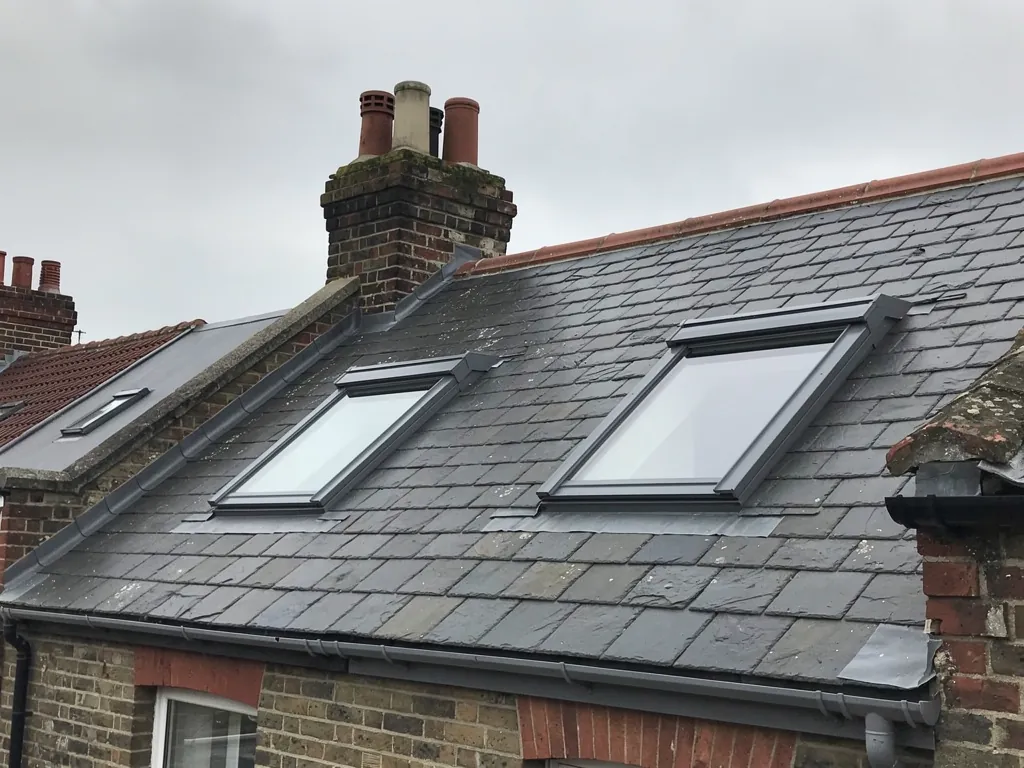
Flashing is the thin sheet metal, usually aluminium or a coated alloy, that bridges the gap between a roof window frame and the roof covering. Whatever you call it, a rooflight or a skylight, rain runs down the roof, meets the window, and the flashing guides it round the sides and away underneath. Without it, the edge of the frame would just be a place where the weather finds its way in.
A flashing kit is the maker's pre-formed set of those pieces: a bottom apron, two side pieces, a top piece, and the fixings. VELUX and other makers supply them cut to suit each window size, so the parts line up with the frame and a fitter is not bending metal on the roof. If you search for "velux flashing kits" you are really looking at a list of kits, each matched to a window size and a type of roof covering.
The part most people never think about is that the kit also carries the window's insulation story. Alongside the metal there are separate collars and membranes that deal with heat and moisture. We get to those in later chapters. For now, remember that the metal keeps rain out and the other parts keep warmth in, and a good fit needs both.
- A bottom piece that sheds water over the tiles below the window.
- Two side pieces that lock into the roof covering at each edge.
- A top piece that sits under the tiles above the window.
- Fixings and a seal strip matched to the frame.
- Optional collars and membranes for insulation and vapour control.
02Coverings
Matching the kit to your roof covering
Kits are made for specific roof coverings, and a mismatch is the quickest way to get a poor result.
Different coverings have different thicknesses and shapes. A flat plain tile is thin and lies flat. A profiled concrete or clay interlocking tile has ridges that rise and fall. Slate is thin but laid in overlapping courses. Each needs a flashing that follows its shape and a different depth of sidepiece so the metal tucks beneath the tiles around it.
Many Essex houses carry plain clay tiles on older roofs, concrete interlocking tiles on post-war and later builds, and slate on some Victorian terraces. A new-town house in Basildon is quite likely to have concrete tiles with a particular profile. Before ordering, we check what you actually have, because a kit for the wrong tile profile will not sit down flat.
If the roof has an unusual covering, such as thick stone slates, shingles, or a standing seam metal sheet, the maker has its own variants or advises a different approach. Tell us early, and we will check the options on survey.
| Roof covering | Flashing behaviour | Watch for |
|---|---|---|
| Plain tile | Thin, flat kit that tucks under each course | Tiles that slip or crack when lifted |
| Interlocking tile | Profiled kit following the ridge and trough | Matching the exact profile height |
| Natural slate | Slate-specific kit, thin edges | Brittle slates near the cut line |
| Other coverings | Maker-specific variant | Availability, lead time |
03Height
Recessed, standard and raised fixing
How far the window sits above or below the roof surface changes the kit, the look and the heat.
A window can be set at the same plane as the roof covering, or sunk a little below it, or raised a little above. Most are fitted in a standard position where the glass roughly follows the tile line. Sinking the window lowers its profile and can look neater from the street, but it needs more care around drainage. Raising it can give extra clearance over a thick covering.
The kit follows the position. A different bottom apron and a different set of fixings may be needed for a recessed or raised window. That is why it is a mistake to buy a window and a flashing kit separately without checking they were meant to go together. We survey first, and the written quote names the kit, not just the window.
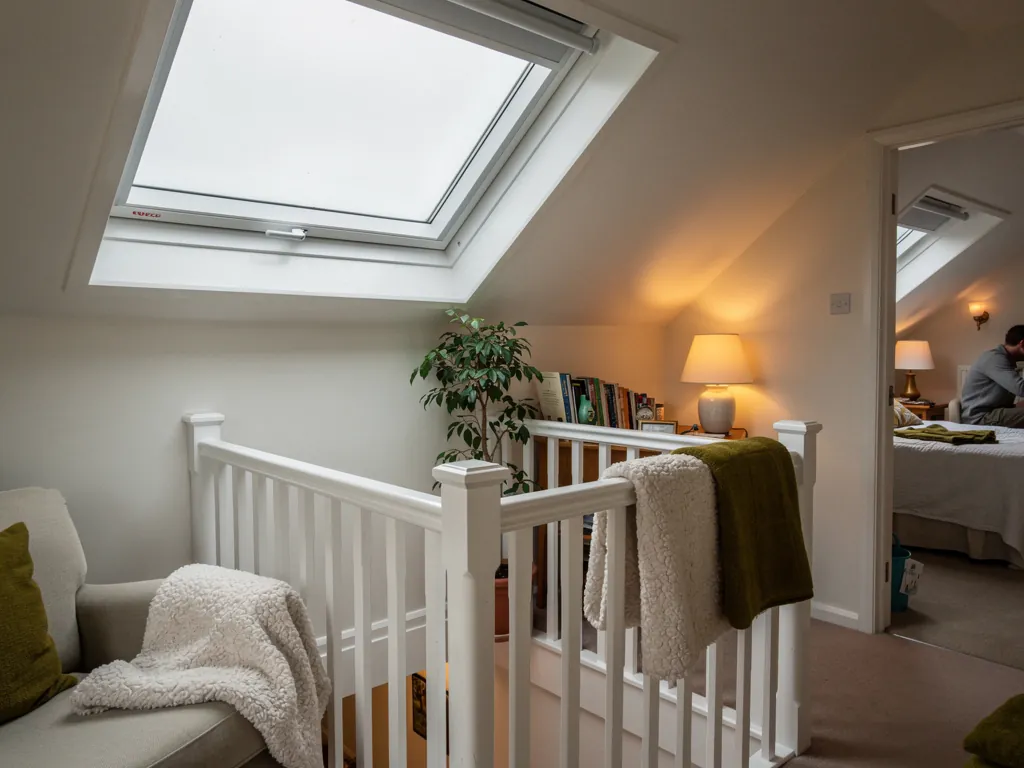
Height also matters for rooms below. A window that is set deep into a thick roof build-up creates a tunnel, called a splay, between the sash and the ceiling. A wide, well-lit splay brings more daylight deep into the room than a narrow one. That relationship is dealt with in our roof window sizes and placement guide.
04Warmth
Insulation collars and why they matter
The metal flashing is the visible part. The insulation collar is the part that stops a cold bridge round the frame.
The gap between a window frame and the rafters around it is small, usually just a few centimetres. If it is stuffed with scraps of offcuts or left empty, a thin ring of cold forms round the window. Condensation collects there, and over a winter it can darken the lining and the ceiling edge.
An insulation collar is a pre-formed foam surround that fits around the frame and fills that gap with a consistent, thermally efficient layer. It slots into the roof opening before the window goes in, and it is one of the cheapest parts of the job that does the most for warmth. When you add it to a replacement, you can often feel the difference around the edges of the room within the first cold spell.
A warm-edge spacer in the glass keeps the rim of the pane warm. A collar keeps the rim of the frame warm. Together they handle the two places a window usually loses heat first. Our guide to warm-edge spacers and thermal breaks goes into the glass side.
A window is only as warm as the gap around it, and that gap is filled by the collar, not the glass.
05Membranes
Underfelt collars and vapour control
Two further parts handle moisture: one keeps rainwater moving, the other keeps room steam out of the roof.
Under the tiles lies a layer of underlay or felt that acts as a second line of defence. Where the window opening cuts through it, an underfelt collar connects the underlay to the window frame and channels any water that gets past the tiles down and out. It is a hidden detail, and it is what separates a tidy fitting from a hopeful one.
On the room side, a vapour control layer or a sealed lining stops warm, damp air from the room reaching the cold roof structure. This matters in a bathroom, a kitchen and a bedroom with several people in it. A neat, airtight finish between the frame and the plasterboard is part of what we mean by a warm fitting, and it sits inside our warm specification.
- Strip the old covering around the opening and remove the old window and flashing.
- Check the rafters, battens and any timber for sound, dry condition.
- Fit the underfelt collar and connect it to the existing underlay.
- Position the insulation collar and the window, fix to the maker's instructions.
- Fit the flashing from the bottom upwards, lapping each piece over the one below.
- Make good the lining and seal the room side with a vapour control layer.
06Groups
Side by side, stacked and combination kits
Two or more windows set close together use a joined kit, not several separate ones.
If two windows sit next to each other, a standard kit would leave a gap or a clumsy double edge between them. A combination kit joins the frames and shares the central flashing, so the line from one window to the next looks continuous. The same idea applies to windows stacked one above the other, where a connecting piece links the top of the lower frame to the base of the upper one.
Combined units are common where a loft room needs more light than a single window can give, or where the line of a roof looks better with a pair. They also have a structural side: the rafter spacing and any trimmers must suit the combined width. That has to be checked before the order is placed, which is another reason a survey comes first.
For flat roofs, the equivalent of flashing is an upstand and a kerb, not a set of aprons. We do not mix those up. Our guide to buying a roof lantern goes into that, for glazed roofs on flat extension tops.
Single window kit
One apron, two sides and a top, sized to one frame. Simple and quick, with the fewest joints.
Combination kit
Shared central flashing joins two or more frames, so the edge between them looks like one unit and sheds water as one.
07Replacing
Do you need a new kit when you replace a window?
Short answer: nearly always yes, and here is why it is worth doing properly.
The old flashing was cut and bent for the old window. Metal fatigues, the edges that were folded can crack when unfolded, and fixing holes have been used. Asking it to work again with a new window is asking for trouble. New window, new kit is the sensible pairing, and the price of the kit is small against the cost of getting scaffolding to the roof a second time.
That also lets us update the insulation details. An older window may have no collar at all, and fitting one now brings a poor installation up to a warmer standard. If you are swapping like for like, the opening stays the same and the job is quicker. If you are moving to a different size, our answer on replacing a VELUX with a bigger one explains what changes. If you only plan to change the glass, replacing a VELUX from inside may apply.
A full window change, frame and glass included, is a controlled fitting under Part L and has to be notified. Where that applies, Building Control hears about it from us. The kit is part of that specification. We fit to current Building Regulations and the work is covered by our 10-year workmanship guarantee.
- 4main flashing pieces in a standard single-window kit: bottom, two sides and top
- 3separate jobs the kit family does: shed water, carry the underlay, and insulate the frame
- 1fitting team on your roof from stripping to making good
08Quote
What to look for on a written quote
A quote that only says "VELUX window, fitted" leaves out the parts that decide how it performs.
Ask for the window type and size, the glazing, the flashing kit and the roof covering it is matched to, the insulation collar, the underfelt collar, the lining and finishing, and the Building Control notification. If the quote lists those clearly, you can set two firms side by side and see what each is actually offering.
Also ask who does the work. We use one fitting team start to finish, so the person who surveys your roof is not handing it to a stranger. Floors and furniture are protected while we work.
Our VELUX windows page describes the service in full, and you can ask for a free survey and written quote through the contact page.
Flashing kit choices that trip people up
Is the flashing kit included with the window?
Usually it is a separate item, matched to the window size and roof covering. That is why the quote should list it. We specify the kit when we survey, so it matches your tiles.
Can I reuse the old flashing on a new window?
It is not a good idea. The old pieces were shaped for the old frame and have been through years of weather. A new kit is a small part of the job and gives you a clean, matched fit.
Does a flashing kit affect how warm the room is?
The metal itself does not, but the insulation collar and membranes sold with the kit family do. They stop the band of chilled air that forms around a poorly packed frame, and the room edges stay warmer.
Are kits the same for every roof?
No. They are made for specific coverings, such as plain tile, interlocking tile or slate, and for different fixing heights. A wrong match will not sit flat against the roof.
Will a new window need planning permission?
Most roof windows on a house fall under permitted development if they meet the conditions, but flats, listed buildings and some conservation areas differ. Check with the council, and see our planning guide for what to ask.

